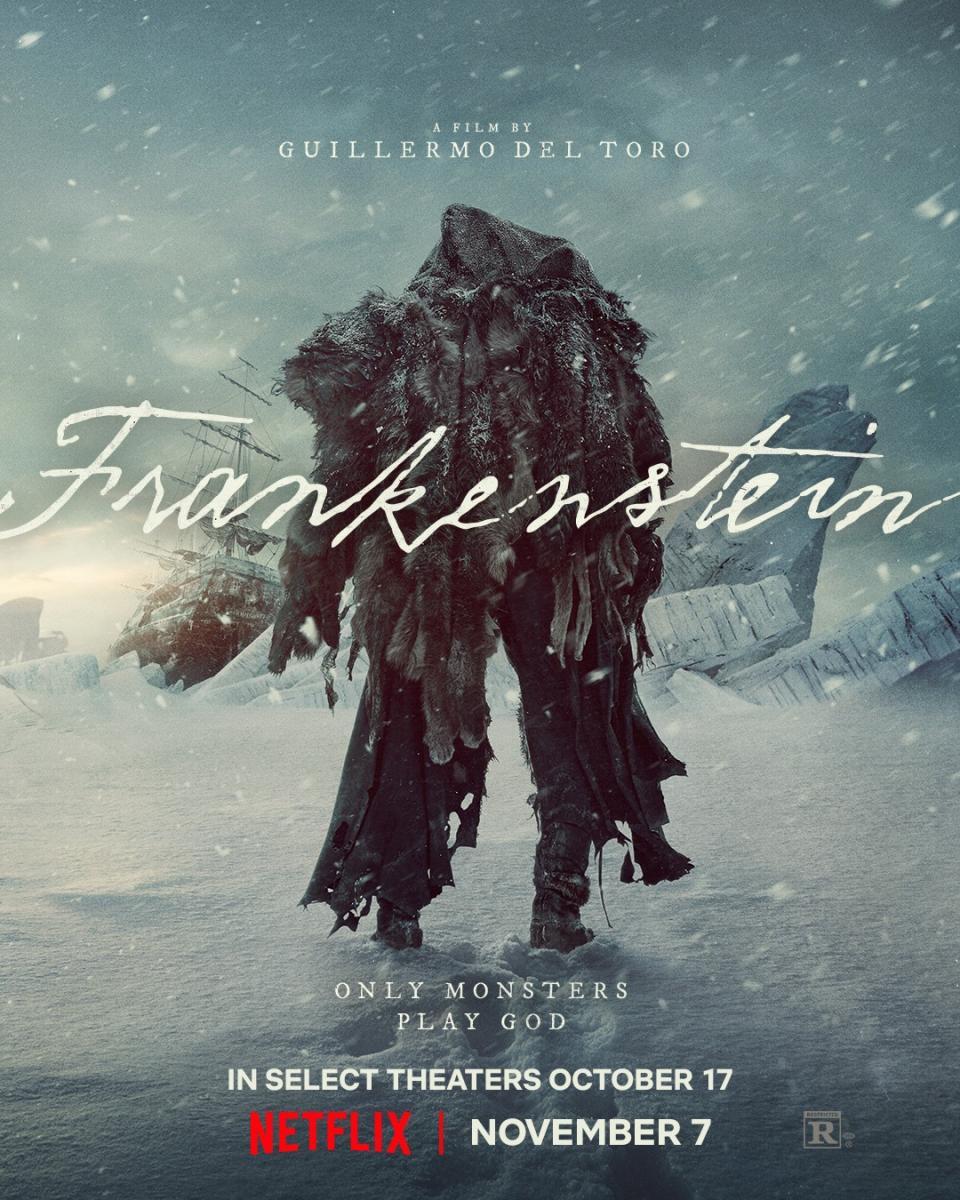
Frankenstein (2025)
Written and directed by Guillermo del Toro, based on the book by Mary Shelley.
I went to see this a few weeks ago in the cinema and I can’t stop thinking about it for all manner of reasons. As a person with a disability, I sometimes find movies can be problematic (and often downright offensive) in their depictions of disability as “monstrous” or “horrible”. In del Toro’s Frankenstein, as in Shelley’s book, the creature is beautifully depicted, he grows as a character and has a definable arc. This creature feels, has curiosity, develops empathy and learns. Above all, he is no Monster!
“Frankenstein: or, the new Prometheus” is one of my favourite gothic novels and thanks to the success of James Whale’s seminal 1931 work starring Boris Karloff as “The Monster”, Frankenstein has become an iconic media object. As much as I love the Whale version and sequel Bride of Frankenstein (1935), I think my favourite iteration is the stage adaptation by Nick Dear performed in 2011 by the National Theatre in London and starting Benedict Cumberbatch and Jonny Lee Miller. (If you can find it, I highly recommend this version.)
Dear’s adaptation closely follows the original text, whereas del Toro’s version embellishes and adds to it, making this treatment all the more risky and interesting. The setting is later, now in the mid 19th century. Victor is older and his brother William is a young man rather than a little boy, and instead of a happy childhood, Victor and William’s father (excellently played by Charles Dance) is abusive and manipulative. Elizabeth is not an orphaned ward of the family but the niece of a new character, Harlander, played with relish and menace by the wonderful Christoph Waltz.
Overall, the production values are sumptuous. Set design, costuming, hair and makeup are all superb and this follows through into cinematography, lighting, framing and the use of colour. And the cast are as carefully curated as the sets they perform in. Oscar Isaac is perfect as the incredibly flawed and egotistical Victor Frankenstein, a man haunted by his mother’s death and his father’s abuse. Jacob Elordi is surprisingly good as the creature though despite all the prosthetics, it’s impossible to make that man look ugly! Though I’ve never thought of her as an actor with great range, Mia Goth is really good in the dual roles of Elizabeth and Victor’s mother – a truly tragic gothic heroine. But Christoph Waltz is just delicious, stealing every scene he’s in.
Grandiose, gothic and gory, this Frankenstein is epic to the point of overwhelming, and displays an over the top grandeur that del Toro has hinted at in previous films. I’m thinking here especially of the dream palace in Pan’s Labyrinth (2006) Cate Blanchett’s gorgeous Art Deco office in Nightmare Alley (2021) and the gloriously gothic mansion in Crimson Peak (2015). Detail is everything, this a movie to be poured over, dissected, examined and discussed like Elizabeth’s insects or Victor’s collection of cadavers.
Frankenstein fits well with del Toro’s previous work in tone and style and in terms of gothic sensibilities, could be seen as an extension of Crimson Peak and like its predecessor, I’m sure Frankenstein will also bear multiple viewings.
At the time of writing, Frankenstein is available to watch in selected theatres and streaming on Netflix. And as always, I highly recommend the big screen experience.

 Debra Manskey