The Ballad of Buster Scruggs

The Ballad of Buster Scruggs 2018

Directed by Joel and Ethan Coen

I’ll start with a disclaimer – I love Westerns. There are particular old titles that bring back memories of Saturday matinees in my home town and late night television viewing with my father and older brother. One of my favourite (and most successful) papers written for my university degree was a comparative analysis of The Searchers (1956) and Serenity (2005). So, I came to The Ballad of Buster Scruggs with quite high expectations.

This latest production from the Coen brothers is an anthology of different stories of the American West, loosely linked to the theme of death. I’ve been a fan of their films all the way back to Blood Simple (1984), and in recent years have studied and analysed their movies and even written academic papers about them. Like all bodies of work that extensive, some of their movies speak to me more than others.  Similarly, anthologies always have stronger and weaker segments and I have to confess that some of these vignettes left me wanting more and a couple didn’t really speak to me at all.

Let’s start with the strengths. The cast is uniformly solid, which is vital with such a wide-ranging film but there are standouts. Tim Blake Nelson is excellent in the titular role and looks like he’s having a lot of fun. Similarly, Tom Waits as the Prospector in “All Gold Canyon” and Liam Neeson as the Impressario in “Meal Ticket” are great but Harry Melling in “Meal Ticket” and Zoe Kazan in “The Gal Who Got Rattled” are outstanding.

Melling is unrecognisable from the obnoxious Dudley Dursley of the Harry Potter films and delivers everything with his expressive face and eyes. Kazan brings something quite special to the girl who finds herself abandoned and trying to take control of her life on a wagon train. I was reminded of a previous Coen film True Grit (2010) with references here to the Midnight Caller story. Framing in this vignette especially is pure homage to John Ford and at times it also reminded me of one of my favourite revisionist westerns, Meek’s Cutoff (2010)

As much as I enjoyed these performances though, it’s the ensemble in the final story, “The Mortal Remains” that had the biggest impact on me. Jonjo O’Neill, Saul Rubinek, Chelcie Ross, the ever reliable Brendan Gleeson and the wonderful Tyne Daly worked perfectly in a dark dreamscape that seemed to me like John Ford’s Stagecoach meets Ingmar Bergman’s The Seventh Seal.

On the downside, I found the CG in some of the earlier pieces annoying and at times, downright clunky – to the point that it took me out of the stories. And I have to say, the first two stories, “The Ballad of Buster Scruggs” and “Near Algodones” really didn’t work for me despite solid performances.

While I believe this did get a limited theatrical release in the UK, the rest of the world is only able to watch it on Netflix. We are living in a fascinating and exciting time for new platforms and methods of film distribution. I sincerely hope it will enable more people to view different movies (particularly independent and foreign language cinema). But once again, as much as I love being able to stream films at home (I’m truly grateful for Netflix and MUBI) I’d have liked the option to be able to see this in a cinema and I have to wonder if some of my issues with the computer graphics would have been assuaged.

Nevertheless, if you like westerns (traditional or revisionist) this is well worth watching!

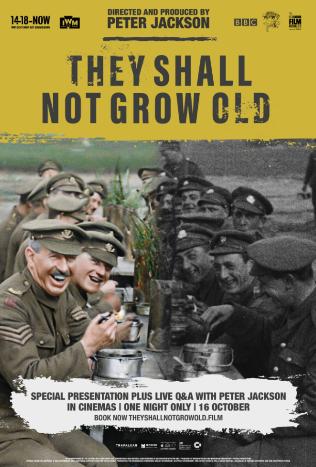
They Shall Not Grow Old

They Shall Not Grow Old 2018

Directed by Peter Jackson

One of the things about getting old is remembering when I was small.

I can recall old men who served in WWI, marching in ever dwindling numbers on Anzac Day and at services on Remembrance Day. Not one of them ever talked about the Great War and as I’ve grown older, and particularly after experiencing this film, I can certainly see why.

Directed and produced by Peter Jackson, this documentary opens with the usual WWI film footage – black and white, jerkily shot, uneven frame rates. About 10 minutes in, it changes to a smooth, full colour film, complete with audio and the effect is nothing short of jaw-dropping.

Jackson had access to the British War Museum’s archives, which included footage from various sources and audio interviews after the war with surviving servicemen. Rather than make the usual war documentary, Jackson and his brilliant team took the footage, shot with hand-cranked cameras and therefore of varying speeds, and smoothed it out with a precision that is simply staggering. The adjusted footage was colourised and then, perhaps most astonishing of all, a team of lip-readers translated what the men were saying to each other and the camera. Voice actors with appropriate regional accents to the regiments depicted gave their images life again. Interspersed with archive audio interviews with survivors, it lends even more gravitas to the camaraderie between the men and the sheer horror of what they experienced. The sound design too is magnificent and relentless, with nearly constant gunfire and shelling but probably only a taste of what these men must have experienced.

The results are an incredibly moving film that really should be mandatory viewing for all adults and a technical triumph for Peter Jackson and his team. It’s caused me to think that Jackson should perhaps make more documentaries than narrative films!

While I cannot recommend this work enough, it isn’t for the faint-hearted. Although I was well prepared, I still found some of the scenes difficult and was moved to tears more than once. However, this film in no way ever glorifies war. Rather, it humanises this brutal conflict in ways that I would not have thought possible. I saw this astonishing documentary on Remembrance Day (Armistice Day in other countries), the 100th anniversary of the end of WWI and I’m very grateful to have seen it in a decent sized cinema with a good sound system – kudos to my local, the State Cinema. To say I was moved is a complete understatement, it was a far more profound experience.

Undoubtedly one of the best films I’ve seen this year.


Widows


Widows 2018

Directed by Steve McQueen

Based on Lynda La Plante’s 6-part Thames Television series from the 1980s, Steve McQueen and Gillian Flynn (author of Gone Girl) have transplanted the story of four women who lose their husbands in a botched robbery into contemporary Chicago. The women have little in common, save a substantial debt left behind by their husbands and these circumstances lead to their joining together to erase the debt and move on with their lives.

This core story is overlaid with a local political tug of war, in the form of the dynastic Irish-American Mulligan family (Robert Duvall and Colin Farrell) and challenger Jamal Manning (Brian Tyree Henry), with his brutal henchman Jatemme Manning (brilliantly portrayed by Daniel Kaluuya).

The ensemble cast is wonderful and (as an Australian) I loved seeing Jackie Weaver and increasingly impressive Elizabeth Debicki as the Russian mother and daughter, but Viola Davis is an absolute standout. Her beautiful, expressive portrayal of a wife at once mourning and angry at the situation she’s left in lights up the screen and is the emotional centre that holds all the threads together.

The balance between the personal and political stories are wonderfully handled, carefully exposed and interwoven, making this so much more than another heist movie. It leads to a climax that I saw coming but still thoroughly enjoyed.

Easily one of my movies of the year.

Jumanji: Welcome to the Jungle

Jumanji: Welcome to the Jungle 2017

Directed by Jake Kasdan.

I can’t believe I didn’t post this when I wrote the review back in at the start of this year! Admittedly, this was on my ever-growing movie pile of shame, and it was shunted out of the way by study and academic writing. Rest assured there’ll be nothing academic here!

Let’s start with an admission that I loved the original Jumanji (1995) and thought it was a great vehicle for Robin Williams. Jon Favreau’s Zathura: A Space Adventure (2005) was very cute but didn’t have quite the same verve that Williams brought to the original. I think the time was right to bring a new film into the stable and this was cleverly added by upgrading Jumanji from a board game to an old console title, hidden away in a school storeroom.

In this version, we have four teens who are magically drawn into Jumanji, while serving detention, cleaning out the aforementioned storeroom. Once they’re in the game there’s all kinds of shenanigans, finding individual strengths they didn’t realise they had, learning teamwork, and even discussions of gender and what constitutes appropriate attire for female game characters (often a point of contention for me).

In essence, we are presented with a series of teen stereotypes playing a series of computer game stereotypes. The cast are uniformly fine. Dwayne Johnson is superbly self-deprecating as the nerdy, shy and supremely unconfident Spencer, who finds himself in a leadership role. Jack Black is delightful as the shallow, self-absorbed Bethany who in the game is a middle aged, overweight professor. Karen Gillan is perfect as shy but dependable Martha, who asks why she’s the only one in a bikini in the game. Kevin Hart is well, Kevin Hart – not a favourite of mine but okay for a film like this. It was great to see New Zealand actor and Flight of the Concords manager, Rhys Darby as the completely deadpan Nigel, and watch out for Rohan Chand (Mowgli 2018) in the bazaar scene.

Computer graphics were suitably “game-like” and the lush colour palette added to the rich feel. Surprisingly, the fight choreography was really very good and narratively it didn’t end up down the rabbit hole of mawkish sentimentality as I thought it might.

I’m increasingly impressed with how Dwayne Johnson has handled his film career, opting for roles that often poke holes in traditional male stereotypes and movies that are decidedly family friendly. This is certainly one to watch with the kids on a rainy day that won’t drive parents away!

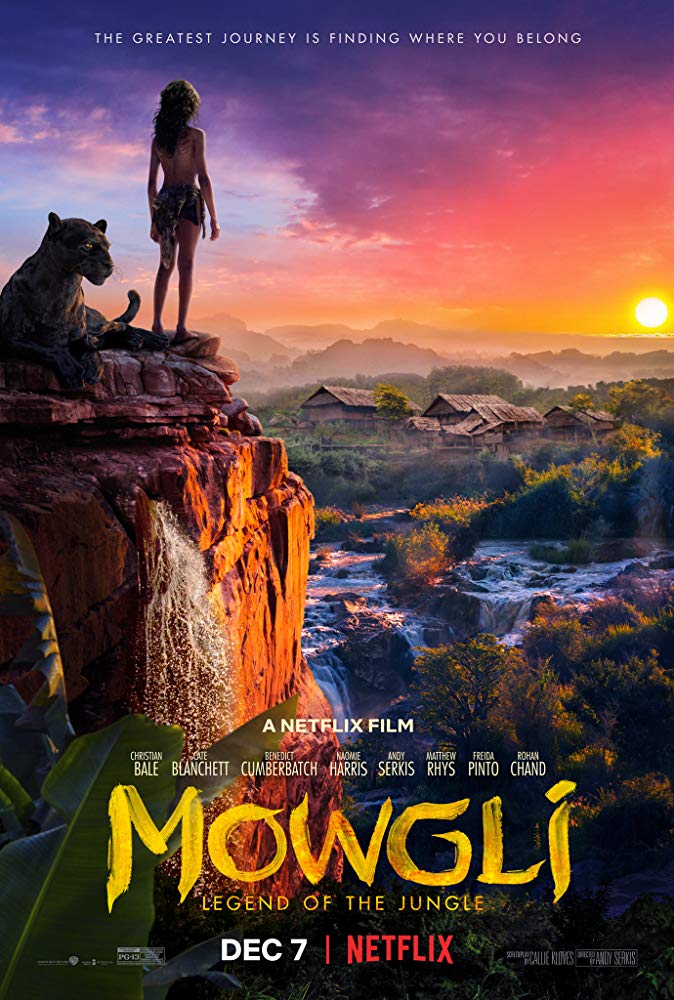
Mowgli: Legend of the Jungle

Mowgli: Legend of the Jungle (2018)

Directed by Andy Serkis

I grew up with parents who read to me every night and some of my all-time favourites were Kipling stories, including The Jungle Books. I still have an old copy of both volumes on my shelves at home. When I was little I remember being incredibly disappointed with the Disney cartoon (yes, I’m that old) because the jungle seemed so clean and safe compared to the grit and peril of Kipling’s original.

There’s been quite a bit of chatter about the standard of computer graphics in this film. I saw it on my home system via Netflix and didn’t find myself being drawn out of the story at any time to consider the scene – a sure way for me to know if I’m distracted by poor CG. Rather, I think Serkis makes good use of the technology available to him. There’s one scene where Mowgli is hiding under water, looking up at Shere Khan lapping from the pool. The shot-reverse shot is gorgeous, delivering tension and realistic water refraction at the same time. Having said that, I don’t know how well some of the set piece action sequences would look on a big screen. As much as I love the new age of delivery models, I regret not being able to go to the cinema to see this.

The voice cast are a wonderful ensemble, featuring some of the best talent currently available. Standouts for me were Peter Mullan, Cate Blanchett, Naomie Harris and Tom Hollander, with Christian Bale, Benedict Cumberbatch and Andy Serkis being their usual reliable selves. But Rohan Chand in the title role is really quite remarkable, with the appropriate mix of fear and determination in his portrayal. I recall he popped up briefly in Jumanji: Welcome to the Jungle and I look forward to seeing more work from this talented young man.

Finally, Andy Serkis has offered a retelling that is much darker than any previous film version and far more adventurous in almost every respect, capturing the feel of the original work. There are comedic moments but overall, the tone is darker and more in keeping with Kipling’s text.

Well worth watching – but not for small children!

Wins & Losses – An Early Summer Update

Birthday bounty!

Well, life got in the way of this blog again – it’s been four whole months since I’ve posted anything! Apologies to all you lovelies who follow my fractured, meandering posts. I had another birthday on the weekend and (besides attaining full membership of the Grumpy Old Ladies League) was given a generous stack of DVD & Blu-ray releases that I don’t have in my collection or I’ve worn out with over-use and I immediately watched Bridge on the River Kwai when I worked out I hadn’t watched it for well over 10 years

It’s true that you only miss something significant when it’s not there. I’ve come to realise in the last few months how much of a fabulous thing writing this blog has been, is and I’m sure, will continue to be in the future. I’ve realised what a significant stress release it is to randomly type a few hundred words about things that matter to me, not because I HAVE to but because I WANT to. So thank you to a few folks who reached out wondering where and how I was, encouraging me to continue – you are gold!

Most of my time in the last few months has been taken up with my big three passions; music education, urban farming and film criticism/university study. Music teaching is gradually winding back for the summer break but I’m constantly enriched and amazed at my marvelous, talented tribe.

With respect to film criticism, I’ve been keeping brief notes on films watched, and there’s quite a backlog to catch up with, many of which I’ll expand out to reviews here. Also, I’ve just completed a unit on Screen Celebrity and Stardom, which takes a cultural industries approach to the generation of celebrity and I’m proud to say I received outstanding marks. Unfortunately, this is also probably the last Screen Studies unit I’ll be doing for my degree course but the good news is I’ll be completing my studies and graduating next year! I also have to do a major project, which I’ll talk about at length here once it’s finalised with my course convenor.

And of course, being early summer here in Tasmania the garden has been going gangbusters despite unseasonably cold and wet conditions. I have a spectacular crop of weeds as a result but the cooler weather didn’t suit most of my heritage tomato seedlings and I’ve had to resort to buying some Burnley Bounty as my main crop. Similarly, my entire basil seed failed this year and I’ve had to buy in punnets and pot them on for the greenhouse. I suspect it was a dud packet and I’ll be contacting the seed merchants more out of courtesy than just to complain. Meanwhile, I’ve had a lovely (albeit small) first crop from the asparagus I grew from seed a couple of years ago, the salad veggies are leaping out of the ground and the fruit trees are laden.

Pricking Basil seedlings into paper pots in the rain last week

There have been some sad losses too. The elderly Ladies Who Lay have sadly been reduced to five, Hipster passed away peacefully in her sleep in early September at an estimated age of 10 years. This is pretty remarkable for a laying hen and I’m pleased her final years were stress free and comfortable, with lots of room to run around in, plenty of things to eat and good earth to scratch. Harder still was losing my beautiful Bella B. Bunny at the beginning of October. She was a truly awful mother, bordering on incompetent, completely disdainful of any other life form (including me most of the time) but I adored her and I’m still trying to adjust to life in the yard without her nosing her way in.

The beautiful Hipster, late of the Ladies Who Lay

Nevertheless, the seasons turn and life continues. The other rabbits Bernard Black and Boudica are well, though dear Boudica is getting noticeably older and slower. I’m inundated with eggs as usual for this time of year which is astonishing as my chickens are commercially, well past their use by date. It just goes to show what plenty of space, a more natural diet and low stress does for any creature’s well-being. Speaking of which, I’m going outside to enjoy the sunshine that’s finally arrived

Take care lovelies wherever you are in the world and I’ll post again soon ❤

My Bella

Isle of Dogs

Isle of Dogs 2018 Directed by Wes Anderson.

I finally got to see this at the end of its cinema run in Hobart and (like so many movies) I’m really pleased I got to see it on a big screen.

This stop-motion extravaganza from Wes Anderson is an absolute triumph in terms of visual styling but with respect to a coherent narrative, I’m not so sure. But I’m tempted to ask if it really matters in this film, which I found incredibly satisfying at many levels.

Like all of Wes Anderson’s work, the degree of visual detail is quite dizzying, to the point of overwhelming. I need to watch this quite a few more times to get the most out of it and for me, that’s part of the joy of Anderson’s film making – it stands up so well to repeat viewing. The cast are superb, with many Anderson regulars including Bill Murray, Frances McDormand, F. Murray Abraham, Harvey Keitel, Bob Balaban and Jeff Goldblum but the standout is Bryan Cranston’s Chief. Having said that, I think it’s really a shame that Scarlett Johansson has so little to do as Nutmeg (Chief’s love interest) and at times, I found Greta Gerwig’s Tracy everything I find annoying about American culture.

This brings me to the many discussions Isle of Dogs has prompted among both critics and audiences about Anderson’s treatment of Japanese people and culture and a perceived coldness in his film making. As a white middle-aged Australian woman, with only a smattering of Japanese, I don’t have a problem with the portrayal of what is obviously a fantasy rendering of Japan. I read the lack of subtitles over much of the Japanese dialogue as a conscious storytelling device, designed to place the audience squarely in the point of view of the dogs, who don’t understand language, just as the teenage hero Atari doesn’t understand the dogs. When required, Frances McDormand’s Interpreter Nelson gives us what we need to know. On the other hand, I really found the character Tracy incredibly annoying and I wondered if she was a parody of the “white saviour” figure that is so prevalent historically in mainstream US cinema (and yes, I’d include Anderson’s 2007 The Darjeeling Limited in that sorry bunch). Personally, I think the character of Tracy could’ve been dropped and the whole film would’ve become more streamlined from a narrative perspective, but there’s always the thought that perhaps her presence is itself an act of protest about current US global attitudes.

With respect to accusations of coldness generally in Anderson’s film making, I frankly don’t buy it. His framing, colour palettes, lens use and even the actors he regularly employs all feed into a very clear cinematic vision that is heavy on detail and offers so much nuance to audiences who care to look a little more deeply.

In conclusion, I don’t think Isle of Dogs is perfect (that title still rests with The Grand Budapest Hotel in my opinion) but it’s really very, very good. If you like Wes Anderson’s oeuvre, I think you’ll really enjoy this incredibly shaggy dog story. Highly recommended.

Extinction (No Spoilers)

Extinction 2018 Directed by Ben Young.

It’s been driven home to me recently that I’m getting old. My local cinema, the State Cinema in North Hobart is putting on a couple of screenings of Stanley Kubrick’s 2001: A Space Odyssey to celebrate the 50th anniversary of its release. But this also gives me cause to celebrate, as 2001 was one of the films that really hooked me into science fiction film, going to the movies in general and remains a film I still love to watch.

This release from Netflix reminded me again what in influence Kubrick still has over the genre, with some early shots from Extinction clearly paying homage. I also spotted a cinematic nod to Ridley Scott’s Alien (which is rarely a bad thing) and in hindsight, these little crumbs set the tone for this flawed but interesting piece of near-future sci-fi.

Essentially, this feature directed by Australian Ben Young is a film about family – what it means to be a family and how those bonds can be stretched, twisted and (in this case) strengthened – but it is quite a dour tale.

Michael Pena plays Peter, a building engineer cum maintenance worker who lives in an architecturally beautiful unnamed city with his engineer/town planner wife (Lizzy Caplan) and his two young daughters. Peter is troubled by dreams of an alien invasion that destroys his family but as his dreams become more intense and frequent, he finds himself increasingly alienated from those he’s trying to protect. I’m not going to spoil anything for those of you who haven’t seen this yet but suffice it to say that Peter’s nightmares turn into reality and the ensuing shenanigans provide the bulk of the film. The first act/set up tells us all we need to know and above all, doesn’t outstay its welcome.

Once the action starts, it wisely relies more on practical than computer generated effects, which at times look very cheap. The tension mounts in a good but fairly predictable way but despite this, overall I found the second act pretty lacklustre. There’s a flatness about the action that took me out of the film on several occasions and I suspect this is one of the issues of trying to be a big blockbuster on a budget. Also, I felt Michael Pena and Lizzy Caplan were sadly wasted in their roles, and the inclusion of Mike Coulter (Luke Cage) as Peter’s boss confused me. One of the things I really liked were the young daughters not being the standard stereotypical “plucky kids” so often seen in this kind of film. They’re not brave or particularly resourceful, they’re just terrified kids, which was refreshing.

The twist in the third act was very good and although I knew something was coming, I didn’t spot it specifically. (Again, no spoilers here – go and see it for yourself!)

Apart from uneven pacing and lacklustre CG, my main gripe with the film is the ending. Apart from clearly leading with a case for a sequel (please don’t do it!) I feel the movie lingered way too long after the denouement. I wanted it to wind up and wave goodbye at least 10 minutes before it did.

Despite this, I am increasingly impressed by Netflix’ foray into original sci-fi film distribution. While Extinction isn’t brilliant, along with Mute, Anon and the wonderful Annihilation (all of which I’ve written about elsewhere but neglected to review here!), Netflix is bringing a welcome breath of new(ish) science fiction to my screens. The ongoing issue I see here is the platform – these films were all made to be at their best on a big screen, with so much of their cinematic value being lost on my home television or laptop.

Or perhaps, I’m just getting old and feeling nostalgic for the magic of seeing something for the first time in a cinema? Nevertheless, I’m still watching with interest!

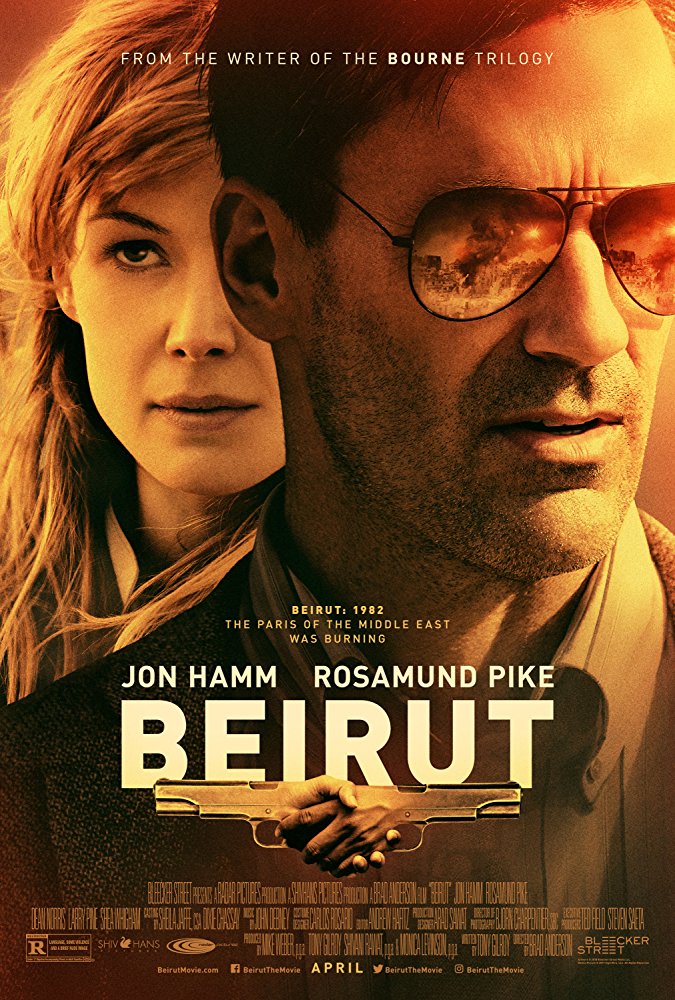
Beirut

Beirut 2018 Directed by Brad Anderson

*No spoilers in this review*

I went to an advanced screening of this over the weekend and it was a packed house. After the film as we were filing out, one of the staff asked a patron if they enjoyed it. The older woman replied “well, I don’t think enjoy is quite the right word. It was very interesting but a bit confusing” and I think that’s a fair assessment of this densely packed political thriller.

Directed by the always visually reliable Brad Anderson, the screenplay is by Tony Gilroy who wrote the Bourne trilogy, Michael Collins and my favourite Star Wars film, Rogue One. There are some fairly difficult issues embedded in this period thriller and at first glance, it would be easy to dismiss it as just another example of western filmmakers using a Middle Eastern location for ethnic flavour and racial stereotyping but I think it offers more on deeper examination.

First and foremost, this is clearly a star vehicle for Jon Hamm (who I last saw and loved in Baby Driver) and he is wonderful as Mason Skiles, the alcoholic and grief stricken former political negotiator. It can’t be denied there are echoes of Don Draper here but I think Hamm pushes beyond that by virtue of Anderson’s direction, a lovingly crafted script and a charismatic performance from Hamm. Rosamund Pike is the perfect choice as his foil and she gives a fine and nuanced performance among a lot of boys as a CIA operative and Skiles’ handler.

The film opens in 1972 and after much calamity and personal heartbreak for Mason Skiles, the action forwards to 1982. The clichés abound (especially when the three characters representing US government interests are introduced), and I noticed some quite heavy symbolism at times – particularly around children playing in and around weapons and rubble and blatant disparities between privilege and poverty. At times I was reminded of films like the Bourne trilogy and even Syriana but ultimately it was an examination of one man in extreme crisis, seeking personal redemption.

Some of it is pretty clunky and (without giving anything away) I wasn’t really on board with the ending but it really is worth it for Jon Hamm’s fine performance. If you want to get the most out of this, it probably pays to have at least a passing knowledge of Middle Eastern history of the period, but at its heart, Beirut is looking at the political tragedy of the time through the lens of personal loss and the notion that terrorists are not born but made.

Beirut opens at the State Cinema, Elizabeth Street, North Hobart Thursday 26th July.

Charade

Charade 1963 Directed by Stanley Donen.

This quite delightful spy thriller/romantic comedy came out in the midst of the Cold War, hot on the coattails of James Bond and could’ve been made by Alfred Hitchcock. Instead, Stanley Donen (who also directed Singin’ in the Rain, Seven Brides for Seven Brothers, Two for the Road and Bedazzled among many others) exercises a light touch on something that could’ve been entirely inconsequential but is made memorable by a particularly fine cast.

There are noir story elements here too, especially in the night time scenes and Paris fits the bill as a most elegant setting for the action. Cary Grant is busy being Cary Grant and Audrey Hepburn is simply gorgeous in her Givenchy outfits and the chemistry between the two leads is everything you want from this kind of film. It’s well backed up by a Henry Mancini score and the great Charles Lang as director of photography.

What takes this up a notch for me is a truly fine supporting cast – George Kennedy, James Coburn, Ned Glass, Jacques Marin, Dominique Minot and the always watchable Walter Matthau. Donen even extends the Hitchcock comparisons by appearing briefly in a scene.

It’s not deep, it’s not the greatest movie ever made but if (like me) you like some escapist and nostalgic fun occasionally, this is extremely entertaining.

Previous Older Entries Next Newer Entries