Death on the Nile

Death on the Nile (2022)

Directed by Kenneth Branagh. Screenplay by Michael Green, based on the novel by Agatha Christie.

This is Kenneth Branagh’s second outing portraying the great Belgian detective, Hercule Poirot and directing the action. As with the previous Murder on the Orient Express (2017), this is an ensemble piece, drawing together some of the biggest names in contemporary cinema, probably all jumping at the chance to work with Branagh – I know I would be!

Like it’s predecessor, there are script adjustments, new characters added to bring it into the 21st century, (which thankfully draws Letitia Wright and Sophie Okonedo into the mix) and a callback character from the previous film. Overall, the cast are fine and it’s everything you’d expect from a film of this genre and style. The set design, costuming cinematography and lighting are sumptuous, coupled with a soundtrack that is period perfect, making this a feast for the senses. And therein lies one of the biggest flaws in this film – it’s too gorgeous. Yes, it serves as an important reminder of the opulent world these people inhabit but I find it detracted from them – the characters I wanted to meet, get to know, empathise with. The beauty overrode the rest of the film and never let me forget I was watching a movie.

I know many who adore Branagh’s skills as an actor and director (I include myself in that club) so what I’m about to say might sound heretical.

My other issue with this movie is Branagh’s take on Poirot, he plays him more as a man of action, which traditionally, Poirot is not. It’s very subjective (isn’t all art?) but after seeing this, I desperately wanted to rewatch David Suchet who, in my opinion, is a far more flamboyant version of the character, yet remains utterly human, unafraid to display his flaws and leans far more heavily into the character from Christie’s many books.

In conclusion, this is not as good as Murder on the Orient Express (2017) which I found far more entertaining. It is incredibly well made and almost too beautiful to look at – but ultimately, lacking in substance. Perfectly fine while it’s on screen but ultimately, forgettable.Death on the Nile is currently screening in selected cinemas in Australia and available to stream on Disney Plus.

The Northman

The Northman 2022

Directed by Robert Eggers. Screenplay by Robert Eggers and Sjon.

I saw The Northman in its opening weekend at a fairly well attended screening at The State, and from the opening scenes (unlike my last cinema outing) you could’ve heard pin drop. This chaotic and extremely bloody film is loosely based on the saga of Amleth, (also the inspiration for Shakespeare’s Hamlet) which forms part of the ‘Gesta Danorum’ or ‘History of the Danes’ from the 12th century.

Here, Eggers has teamed with Icelandic writer Sjon, who also wrote the screenplay for the much lauded Lamb (2021). The result is a mesmerising fever dream of epic proportions. Featuring Alexander Skarsgård, Anya Taylor-Joy, Claes Bang, Nicole Kidman and Ethan Hawke, this boasts a great supporting cast, including Willem Dafoe, Ingvar Sigurdsson and the wonderful Björk. The production was one of many delayed by Covid, but I think in this case, it has worked in favour of The Northman, with the end result a very polished production.

There are many, MANY fight sequences and they’re excellently choreographed by C C Smiff and shot by cinematographer Jarin Blaschke, a constant collaborator on all Eggers’ features. The framing throughout is superb but one scene in particular has stayed with me, a beserker raid on a village that contains a lengthy tracking shot through a village. Filmed in one take, it is wonderfully balletic as well as incredibly bloody. All praise too for stunt coordinator Jòn Vidar Ambórsson and his team, who really made me wince and occasionally, gasp for breath! The original soundtrack by Robin Carolan and Sebastian Gainsborough is perfect – front and centre when required and unobtrusive for the remainder. Similarly, there’s been a lot of work poured into costuming and historical accuracy, right down to a valkyrie with dental adornments and a he-witch in women’s clothing – real practices in Iron Age Viking culture.

Having a much bigger budget for this third feature has also opened up new horizons (literally) for Eggers. After the intentionally stifling feel of the New England forest (and Thomasin’s tiny family cabin) in The Witch (2015) and the similarly claustrophobic feel of The Lighthouse (2019), the broad horizons and multiple locations of The Northman give an appropriate sweeping, epic feel to this saga of vengeance and love. It fleetingly draws a shade of grey over Amleth’s quest (a thread that could’ve been pulled a little more I feel) but it remains a top class epic revenge saga.

If like me, you’re a fan of Eggers’ brand of visceral dark horror (yes, it is a horror movie), I’m sure you’ll enjoy this and, like his previous films, I’m sure this will stand repeated rewatching. But be aware, it isn’t for the squeamish or faint hearted. The Northman is currently in wide release globally and I suggest seeing it on the biggest screen possible. Very highly recommended.

Everything Everywhere All At Once

Everything Everywhere All At Once (2022)

Written and directed by Daniel Kwan and Daniel Scheinert (as the Daniels)

I saw this with friends at my local cinema (the State) and while it was great to see on the big screen, our experience was unfortunately marred by some very inappropriately noisy young girls, which is always sad. We went in purposely knowing very little about the film, only the main cast and that it’s an A24 release. It’s my preferred way to see anything – and we weren’t disappointed.

This film is made up of very many thematic pieces. Part absurdist comedy, part family drama, part action blockbuster, part science fiction but at it’s core, I felt it was a thoughtful examination of existentialism on one hand and nihilism on the other. There are many film references, stretching from Hong Kong action cinema to Disney animation, and I even found myself thinking of In the Mood For Love (2000) with some very beautifully lit and heartfelt alley scenes. Perhaps my biggest takeaway from this, is that it isn’t based on an existing property, it’s a wholly original work (albeit a cinematic homage) and that makes it all the more refreshing.

The cast are top notch but my standouts are Michelle Yeoh (Evelyn Wang), the astonishing Jamie Lee Curtis (Deirdre Beaubeirdre) and Stephanie Hsu (Joy Wang). They’re ably supported by veteran actor James Hong (Gong Gong) and Ke Huy Kwan (Waymond Wang) who as a child actor, played Short Round in Indiana Jones and the Temple of Doom (1984).

There are moments that are outrageously, laugh-out-loud funny, some blindingly great action sequences (where Yeoh is stunning) and moments when I found myself in tears, thinking of my own fraught family relationships. For the most part, the pacing is frenetic, at times reminiscent of Edgar Wright’s smash cuts from Scott Pilgrim vs The World (2010) but it’s interspersed with quieter, reflective moments that (for me, at least) will remain long after the movie has ended.

Overall, I found the whole far greater than the sum of its many parts and a thoroughly entertaining ride. Try and see it on the biggest screen possible. Very highly recommended.

Everything Everywhere All At Once is currently in wide release globally .

Blood of Dracula’s Castle

Blood of Dracula’s Castle 1969

Directed by Al Adamson. Written by Rex Carlton.

One of my favourite film podcasts, The Evolution of Horror is about to embark on their 8th season in coming weeks, and this time they’re focusing on vampires. As a lifelong fan of this subgenre, it got me thinking about vampire films I HAVEN’T seen. And that led me to Blood of Dracula’s Castle (1969) and what a wild ride it was!

Directed by Al Adamson, this definitely falls into the “so bad, it’s almost good” category, making it one of his better efforts. Adamson was a classic director of exploitation films, mostly pitched at the drive-in cinema market, which was hugely popular in the US and Australia in the 60s and 70s. As a child of that era, I was genuinely surprised I hadn’t seen this one before. It did have something of a difficult start, being filmed in 1966 and not released until 1969 and there’s an extended version, released separately as Dracula’s Castle.

The story (quite a convoluted beast) finds Dracula and his wife (played with delicious wit by veterans Alexander D’Arcy and Paula Raymond) living the high life under the alias Count and Countess Townsend in a Gothic castle, complete with an inarticulate beast-like servant, gruff and ghoulish butler (played with much tongue-in-cheek by the great John Carradine) and a dungeon inhabited by chained young women, whose blood is slowly drained to sustain the vampires. And it’s all set in the wilds of… California!

But the Count and Countess are only tenants, and the property is inherited by a hip young photographer and his bikini-model fiance who not only want a tour of the property but want to move in! There’s also a more interesting sub-plot involving a psychopathic killer (and friend of the Count & Countess) which gets kind of left behind.

Despite its multitude of flaws, I really quite enjoyed this very camp romp, probably the only things missing were Frankie Avalon and Annette Funicello. Blood of Dracula’s Castle is a fun excursion into 60s Californian Gothic – but certainly no masterpiece! It’s currently available to stream for free on Tubi in Australia though the resolution is sadly, quite poor.

The Adam Project

The Adam Project (2022)

Directed by Shawn Levy. Written by Jonathon Tropper, T. S. Nowlin, Jennifer Flackett and Mark Levin

This Netflix production is another collaboration from Shawn Levy and Ryan Reynolds, after last year’s Oscar nominated Free Guy (2021). Shot entirely in British Columbia Canada, The Adam Project is essentially an action movie that straddles science fiction (time travel specifically), coming of age, comedy and family drama – especially the currently popular “Bad Dads” concept. (I think Bad Dads have become so prevalent it should be recognised as a subgenre all on its own!)

A common problem with mixing so many ideas in the same movie is that everything gets messy, fundamentals can be diluted and some important things get lost along the way. The quality cast really helps here, led by Ryan Reynolds as Adam Reed, who (while perfectly fine) doesn’t deviate from his usual charming performance. Jennifer Garner, Mark Ruffalo, Zoe Saldana and Catherine Keener all make the most of their roles, but the standout for me is Walker Scobell as 12 year old Adam. His delivery is on point, capturing Reynolds’ easy going charm perfectly.

While this is great family viewing, it’s one of those films that’s fine while you’re watching it but readily forgotten after the event. The Adam Project is currently available to stream on Netflix in most territories, including Australia.

Black Christmas

Black Christmas (1974)

Directed by Bob Clark, written by Roy Moore.

Bob Clark’s 1974 Canadian holiday horror is something of a minor masterpiece that holds up even today. Featuring a very strong cast, including John Saxon, Olivia Hussey, Kier Dullea and Margot Kidder, this is considered by many horror buffs as the proto- slasher that paved the way for Carpenter’s Halloween (1978) – even more than Hitchcock’s Psycho (1962) or Michael Powell’s brilliant and (sadly, often overlooked) Peeping Tom (1960).

There are many reasons for Black Christmas‘ success beyond its fabulous cast. The cinematography by Reg Morris is certainly a cut above a lot of horror releases of the day. Like many Hitchcock films, it employs the technique of not showing a lot of blood and gore (apart from a few key scenes) but rather, character reactions which are far more chilling. It was also an early adopter of not showing the antagonist but filming a moving camera from the killer’s PoV.

The music by Carl Zittrer is minimal and incredibly atmospheric and was considered very avant garde for its day. Some of the choices haven’t aged so well but for the most it adds a great deal to the narrative tension without getting in the way.

But above all, the story is solid and Roy Moore’s screenplay allows for plenty of development, giving the actors a lot to work with. This results in a film inhabited mostly by believable, fully fleshed out characters. It also allows room for some really quite funny moments that doesn’t feel out of place or tacked on. Marian Waldman’s deliciously drunk Mrs Mac is a particularly fine example of this.

I confess I haven’t seen the remakes (I think there are two?) but I don’t feel it would do much other than make me want to watch this again. Maybe that’s not such a bad thing.
Sadly, Black Christmas isn’t available currently to stream in Australia, but the fine folks at Newcastle After Dark have it on their YouTube channel.

Titane

Titane (2021)
Directed and written by Julia Ducournau.

I watched this a week ago and I’ve been sitting on my review for days, tweaking words, trying to find the language to describe it without spoiling it. Seriously, this movie is difficult, demanding, utterly insane, at times hard to watch but it’s also blackly funny, deeply poignant but impossible to neglect and has stayed with me relentlessly all week.

Titane is Ducournau’s second feature and, in my opinion, a better, more interesting film than her debut, Raw (2017), which left me feeling distanced, at arm’s length from the story and the characters. Where Raw was clearly examining eating disorders and body image, Titane examines body image but particularly drills down into gender roles.

It’s also a film of two distinct halves, the ultra violent, hypersexualised first half, melancholic examination of belonging in the other. Body horror abounds throughout, so this film is not for everyone, certainly not for the faint hearted but unlike so many films that sit in the genre, none of the violence feels gratuitous.

Two riveting central performances ground the film. Comparative newcomer Agathe Rousselle is the tough and uncompromising Alexia, and French national treasure Vincent Lindon, the ageing firefighter trying to defy the march of time. Neither of them are particularly likeable (especially Alexia) but ultimately both are heartbreakingly relatable.

Ducournau is a wonderful “show, don’t tell” filmmaker and I can see where she was influenced by Hitchcock generally and Vertigo (1958) specifically, but Titane asks more questions than it answers and will haunt you all the while. I sincerely hope it is a huge success outside of its native France, where it won the Cannes Festival Palme D’Or earlier this year. But equally, I hope some producer with dollar signs in their eyes DOESN’T try and make an English language version – that would be exploitation!

Undoubtedly one of the most original films I’ve seen in ages, I think it’s a masterpiece that will stand the test of time. Titane is currently showing in select cinemas throughout Australia.

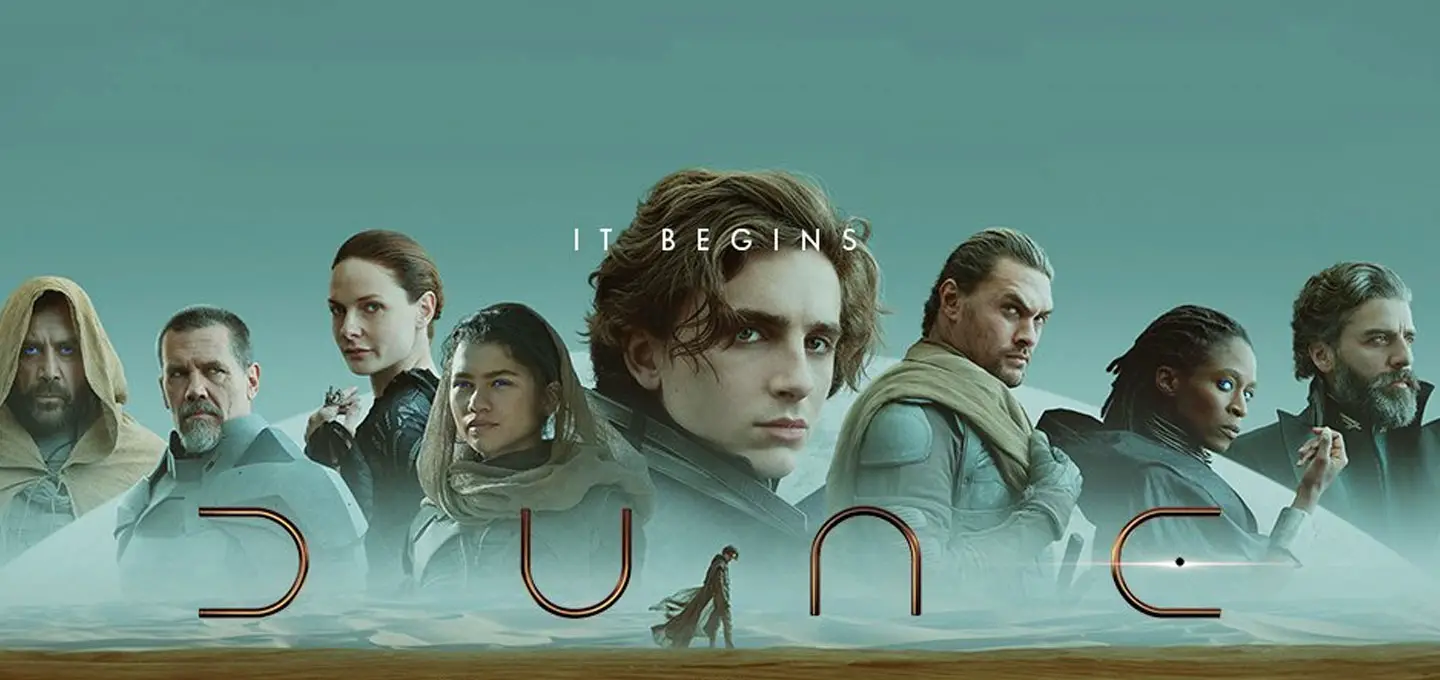
Dune (Part One)

Dune (2021)
Directed by Denis Villeneuve. Screenplay by Eric Roth, Jon Spaihts and Denis Villeneuve (based on the novel by Frank Herbert).

Yesterday was my birthday, and I’m very pleased Warner Brothers got the memo and arranged to open Dune as part of my birthday shenanigans. It was almost as good as the year Dave Grohl (Foo Fighters) and Jack Black (Tenacious D) decided to play a few tunes to celebrate my day.

I have to admit, I was quite trepidacious about this film. First published in 1965, Dune was one of my favourite sci-fi novels when I was young and I’ve been very disappointed by previous attempts to commit it to screen. The problem is Frank Herbert’s book is a personal story with lots of inner monologue and detail, but simultaneously, a sprawling political epic, requiring loads of exposition, alien (to us) technology and expansive exteriors. Hence, my concerns.

Fortunately, after the opening scenes and some slow-paced exposition, I felt myself start to relax a little. Looking to his previous work on Arrival (2016) and Blade Runner 2049 (2017) Denis Villeneuve is the right director at the right time for this story, blending the enormity of the landscape, the political intrigues with the very personal journey of Paul Atreides. And Villeneuve is obviously prepared to take his time over the story, spreading it out over two films. Part Two is currently in pre-production and scheduled for release in 2023.

The cast are uniformly very good, there are too many supporting roles to mention but I did laugh at Stellan Skarsgard as Baron Harkonnen (if you’ve seen the film, you’ll know what I mean). Timothée Chalamet really shines as Paul and thanks to careful styling, lighting and makeup his scenes with Oscar Isaac (who is excellent as Leto Atreides) really are convincing as father and son. Rebecca Ferguson has the difficult role of Jessica, who only expresses her doubts in the book as interior monologue, and Ferguson does well to occasionally let her strong facade slip. I was concerned that Villeneuve was falling into the “absent love interest” pit (remember Liv Tyler in Ad Astra (2019)?) but I feel there was enough depth to carry Zendaya’s Chani through this installment.

Technology is beautifully realised throughout, and similar to Villeneuve’s other work, machinery and spaceships are realistically depicted, having weight and substance – they feel like they belong there. Special effects are very well done uniformly and the blending from dreams to the real world is artfully done. Hats off to the special effects team! Similarly, the costuming is by turns lavish, practical and at times austere, all beautifully designed by Robert Morgan and Jacqueline West.

The fabulous work of DoP Greig Fraser is aided by some excellent editing by Joe Walker, bringing a strong sense of reality to the action set pieces and a David Lean sensibility to the desert vistas. As always, the score by Hans Zimmer draws all the threads together quite wonderfully, enriching the overall experience without getting in the way.

Dune is not a short film (running time 2h 35m) and it is certainly a slow burn but this is not just another bloated action sci-fi. It isn’t cowboys in space or superheroes saving everything in sight, but a dense, wide-ranging story of epic proportions. It is undoubtedly one of my cinema highlights of 2021. Now showing in cinemas in Australia.

Last Night in Soho

Last Night in Soho (2021)
Directed by Edgar Wright. Screenplay by Krysty Wilson-Cairns & Edgar Wright.

I’m going to fess up at the start that I’m a big fan of Edgar Wright’s work all the way back to Spaced (1999-2001). While I really like Scott Pilgrim Versus the World (2010), Hot Fuzz (2007) and Shaun of the Dead (2004) from the Cornetto Trilogy remain two of my mainstay “comfort” films and Baby Driver (2017) is also a firm favourite. I think World’s End (2013) remains the only disappointment for me, but I’m well overdue to rewatch it!

A lot of people don’t like his “smash cut” style using very quick image clips, accompanied by foley sound &/or music, finding it annoying or distracting. Admittedly, it does take a certain amount of concentration, but in many ways it overtook the classical montage as an effective means of enhancing story and moving the audience down particular narrative pathways without taking loads of in-film time.

In Last Night in Soho however, I think Wright and his team have moved beyond the smash cut into something far more complicated and cinematic. There’s a film technique called the Texas (or Cowboy) Switch, (another trick Wright has used in previous films) and in first act this is pushed to the limit with quite astonishing results. The sound and visual design are stunning throughout but scenes in the first act are aurally and visually superb, beautifully choreographed, performed and shot.

The cast are uniformly excellent, and include 60s icons Rita Tushingham, Terrence Stamp and the late Diana Rigg in her last film role. Younger talent include Anya Taylor-Joy as the drop-dead gorgeous Sandie, Matt Smith as the deliciously lecherous Jack and Michael Ajao as John, but for me it’s Thomasin McKenzie who provides the glue that holds the film together. Her portrayal of fashion design student Ellie is heartbreakingly vulnerable and feisty in equal measure.

As with most of my reviews, I’m not going to give any spoilers but Last Night in Soho explores some quite serious horror themes, undiluted by humour as in Shaun of the Dead or Hot Fuzz but (as usual in Wright’s films) underpinned by a killer soundtrack. It is by no means a perfect film (I found the second act struggled to maintain momentum) but this is the work of a mature filmmaker. Here, Wright has moved way beyond the quirky smash cut and quick one-liner and made a really interesting horror movie, tinged with pathos and mystery.

Like all of Wright’s films, it’s cleverly made, has a great script and pays homage to both London and the 1960s – and it’s well worth seeing!

The Green Knight

The Green Knight (2021)
Directed & written for the screen by David Lowery

I’ve read a number of very disparaging comments about this movie but I really don’t get it. I have to question how familiar they are with Arthurian legends in general, let alone the epic tale of Gawain. The only conclusion I can draw is all these stories are shrouded in a mediaeval mysticism that could seem nonsensical or over the top to 21st century viewers. And this version of the Arthurian legend is visually sumptuous. Gloriously lit and shot by DoP (and frequent Lowery collaborator), Andrew Droz Palermo, this retelling plays deeply into the fantasy elements of the famous 14th century story.

Watching, I was reminded a few times of Terry Gilliam but more (particularly given the source) of John Boorman’s insanely flawed Excalibur (1981), which remains with Zardoz (1974) some of my not-so-guilty cinematic pleasures. While both Boorman especially and Gilliam to some extent veer into self indulgence, I don’t feel Lowery’s fallen into the same trap.

The casting is excellent and performances uniformly superb. Dev Patel has just the right balance of physicality, pride and foolishness to bring Gawain to life on his perilous journey to fulfill his bargain with the Green Knight, and he is ably supported by a great ensemble.

My only complaint is that this only had a very limited cinematic release here in Tasmania and I had to watch it at home via Amazon Prime on my big(ish) television. Nevertheless, it’s a glorious retelling of an epic story and, in my opinion, worth watching on any screen.

Previous Older Entries Next Newer Entries