One Battle After Another – Spoiler Free

One Battle After Another (2025)

Directed by Paul Thomas Anderson. Screenplay by Paul Thomas Anderson, inspired by the novel “Vineland” by Thomas Pynchon.

It’s hard to know where to start discussing this epic work without spoilers, so if this review seems particularly sketchy, I’m not offering apologies. It’s personal preference but most of my friends and I like to go in blind to a film rather than know what’s going on before it happens.

One Battle After Another is an interwoven tale of revolutionaries, lust, love and loss, overlaid with a strong political thread. But rather than a straight up political drama, it is by turns a heartbreaking family drama, a fabulous action movie and above all, a truly edge-of-the-seat thriller, punctuated by some nice, dry comedic beats (mostly from Leonardo DiCaprio, who at times channels his inner Jeff Bridges).

I remember reading Vineland in the early 90s and being put off by some the blatant stereotypes Pynchon employed. I need to go back and reread the book, but I was struck by the difference here of strong character development (especially of DiCaprio and Chase Infiniti’s characters) across the film. The cast are absolutely on point throughout, Sean Penn is creepy as hell, Benicio Del Toro has never been cooler and I think this might be my favourite Leonardo DiCaprio role. Teyana Taylor, Regina Hall and especially Chase Infiniti (in her first feature film role) are all excellent.

At 2 hr 41 mins this is a long film but the editing by Andy Jurgensen is so beautifully executed, I really didn’t notice or mind. Similarly, DoP Michael Bauman does great work, bringing one of the most visceral and inventive car chases I’ve seen in a very long time. The original score by the masterful Jonny Greenwood gives tremendous support to the action and often says more than pages of dialogue could.

Above all, I think this is a very brave film and an important one, made at an extremely difficult period in US and world history. I predict it will become something of a touchstone for these insane times we live in – at least that’s my hope.

One Battle After Another is currently in wide cinema release globally. Very highly recommended. Go and see it!
Eddington – Spoiler Free

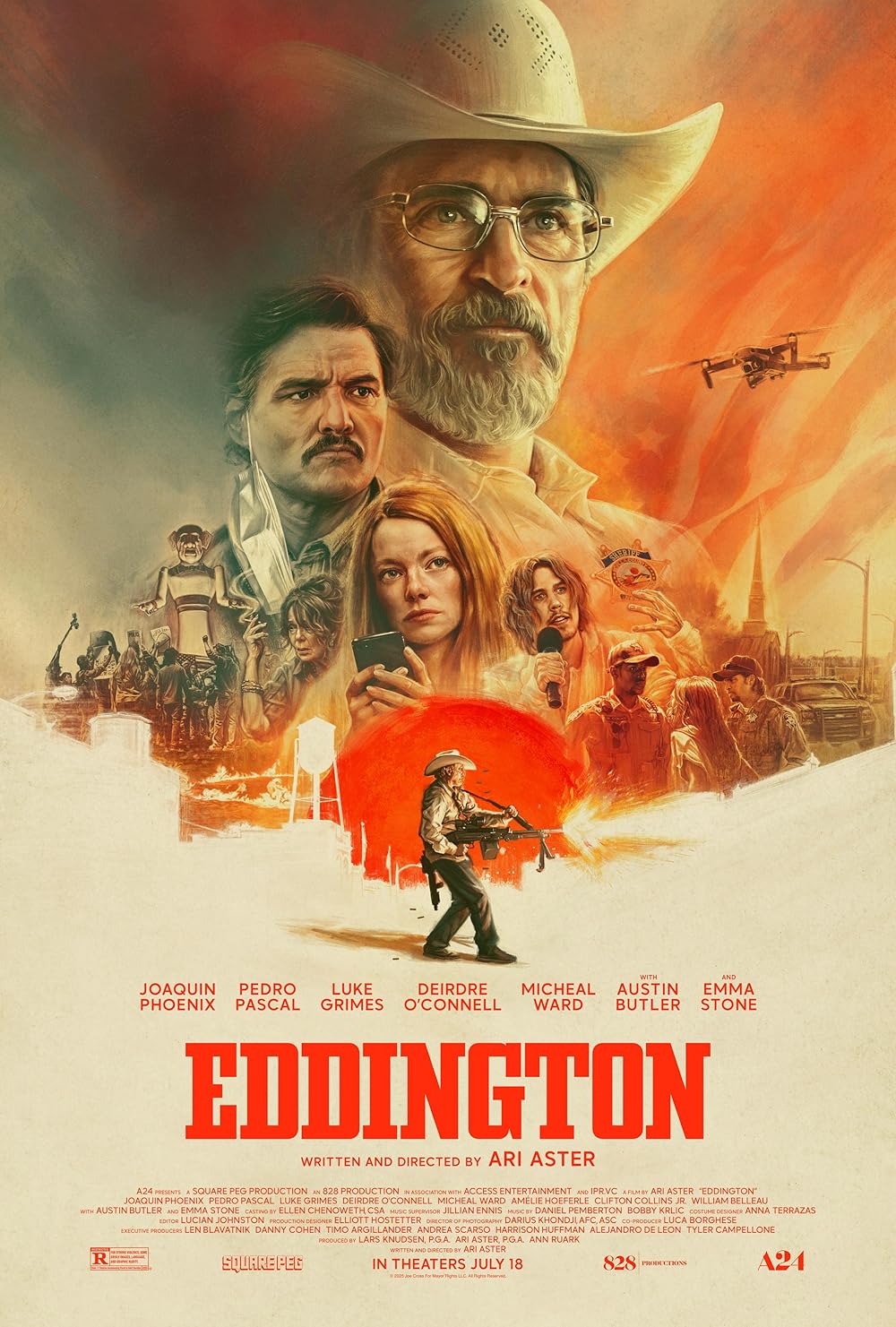
Eddington (2025)

Written & directed by Ari Aster

There’s a meme currently doing the rounds of social media regarding Ari Aster and the text goes something like this. “Hereditary – don’t watch with your mother; Midsommar – don’t watch with your girlfriend; Eddington – don’t watch”. For me, social media telling me not to watch something is like a red rag to a bull, and strangely plays into this incredible, messy, fever dream of a movie. After seeing it earlier today, my prediction is that Eddington will be one of the most divisive movies of the year.

The film is set in the small New Mexico town of Eddington in that most uncertain year of 2020. Social media plays an important role here, with a global pandemic, disaffected youth, the black lives matter movement and homelessness mixing it with conspiracy theorists, corporate interests and anti-vax/anti-mask rhetoric. Add in the world’s need to upload everything live to Instagram and things get very muddled very quickly. The town sheriff, (superbly played by Joachim Phoenix) is at loggerheads with the mayor (portrayed by the always excellent Pedro Pascal) and the tension builds quickly.

Without spoiling anything, in my opinion there are many things wrong with this film. First, at two and a half hours, it’s way too long and the last hour drags dreadfully. Second, I felt like Aster was trying to do too much within the confines of a single feature film – there are literally too many stories crammed in here and it seemed he only scratched the surface with most of them. This means we only see glimpses of characters who had untapped and doubtless fascinating stories, especially Emma Stone as the sheriff’s wife, Louise, William Belleau as Butterfly Jimenez and Micheal Ward as Deputy Michael Cooke.

On the other hand, there are some wonderful things about this movie. The anxiety Aster builds is stellar, my friends and I were on the edge of our seats for a good deal of the film. The cinematography, framing and lighting are exceptionally good, DoP Darius Khondji did an excellent job. Similarly, the original music by Bobby Krlic and Daniel Pemberton is absolutely on point and doesn’t get in the way. There are some truly lovely satiric touches throughout, both verbal and visual blink-and-you’ll-miss-it gems that are worth seeing. The cast are uniformly solid, though as mentioned above, often underused. But above all, Joachim Phoenix is absolutely wonderful as the increasingly paranoid, perplexed and out of his depth sheriff, Joe Cross. If nothing else, it’s worth seeing Eddington for his incredible performance.

In conclusion, Eddington (like all films) won’t be everyone’s cup of tea and it really is very messy but if that’s accidental or by design is up for debate. Despite what I consider a failure, I can see what Aster was aiming for and I think he has to be applauded for trying what most directors wouldn’t dare attempt. I honestly cannot say any of us enjoyed this movie but my friends and I had to indulge in a lengthy lunch afterwards to debrief, so there’s another bonus! Make of that what you will, but anytime a film generates discussion like this is a good thing in my opinion.

Eddington is currently in wide cinema release globally. Please let me know if you see it and what you think of it.

Bring Her Back – Spoiler Free

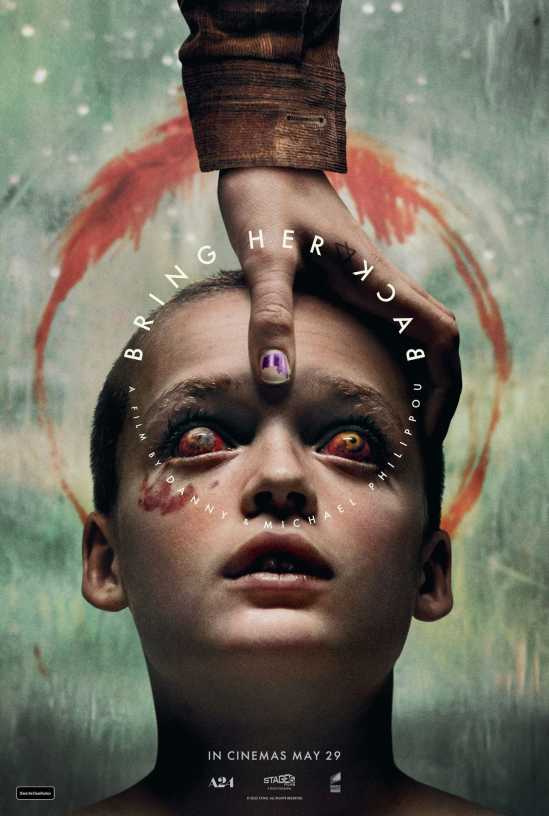
Bring Her Back (2025)

Directed by Danny and Michael Philippou. Written by Danny Philippou and Bill Hinzman

Going into this sophomore feature from the Philippou brothers, I knew next to nothing about it, and I recommend that as a default position for watching most film. So I’m going to give as little away as possible, in the hope that many of you will go and see this on the big screen and be as surprised and ultimately, entertained as I was.

I did know it was an uncomfortable watch for many people and it stars Sally Hawkins, whose work is diverse and always top notch in my opinion. As Laura, she is a force of nature and the ticket price is worth it just for her heartfelt and at times, downright desperate performance. The younger cast members are also excellent, vision impaired Sora Wong is particularly good, especially considering her lack of previous acting experience.

Bring Her Back is very intense, doesn’t shy away from depictions of gore (I can see the influence of French New Extremity clearly here) so it’s not for the squeamish. The intensity is accentuated by some great camera work (hats off to DoP Aaron McLisky), the use of tight framing that creates a claustrophobic atmosphere and the simplicity of diegetic sound, especially rain falling. The score by award-winning screen composer, Cornel Wilczek is unobtrusive and helps build audience anxiety, and at a tight 104 minutes, this film doesn’t outstay it’s welcome.

At it’s core, this is an exploration of grief from a variety of viewpoints. From the superficiality of contemporary funeral rites to the depths of darkness, guilt and depression. (As an aside, I’d love to hear US mortician Caitlin Doughty discuss and critique various funeral practices in contemporary horror, I think it’d make an excellent video essay.) The tension is maintained through a combination of great script, visuals and sound, excellent editing and exceptional performances – both in front and behind the camera.

Ultimately, I can’t describe this as an enjoyable watch, but as a lifelong horror fan I do consider it entertaining. It’s caused me to consider people I’ve lost along the way and how I’ve processed/still processing the grief, something I consider a healthy use of my time. I haven’t watched the Philippou brothers first feature, Talk To Me (2022) but after seeing Bring Her Back, I’ll be rectifying that very soon.

Bring Her Back is currently in wide distribution globally. Highly recommended.

Alien: Romulus – Spoiler Free

Alien: Romulus (2024)

I’m old enough to remember going to see Ridley Scott’s Alien (1979) on first release and being totally blindsided by how such a simple Hitchcockian premise could deliver so much. It’s become one of my all time favourites and I watch it at least once a year. Aliens (1986) directed by James Cameron (the undisputed king of sequels) is an excellent war movie, though I don’t rate it as highly as some. Even Alien 3 (1992) had moments, though I’m sure David Fincher would disagree! Beyond that, it all turns to mush in my mind.

So, given my increasing disillusionment with recent entries into the franchise, I went into this with some reservations. However, there’s much to commend this film. The cast are good, particularly David Jonsson in the pivotal role of Andy, the sound design is excellent and director Fede Alvarez’s rule of using practical effects wherever possible really improves the visual aesthetic. While the cinematography from Galo Olivarez is mostly on point, at times the lighting is abysmal and it’s difficult to distinguish what we’re supposed to be focusing on. More than once, I found my eyes wandering away from centre frame and them scrambling to catch up with the action. This also served to diffuse rather than enhance tension.

There are the mandatory jump scares and plenty of Alienesque gore but in the final analysis, it’s the script that lets everything down, with too many incredibly cheap jump scares and even cheaper call backs to much better films.

I’ve heard Alien: Romulus described as a greatest hits album performed by a cover band. This is probably a little harsh but ultimately, I did find it a disappointment. Nevertheless, I always encourage people to go and see it yourselves and make up your own mind.

Alien: Romulus is currently in wide cinematic release globally

Avengers: Endgame *NO SPOILERS*

Avengers: Endgame (2019) *NO SPOILERS*

Directed by Anthony & Joe Russo.

I just want to start by saying that this is more a reaction piece than a full-blown review and will contain nothing that will reveal any main story points. My personal opinion is there’s a special hell for people who spoil movies – and a particularly nasty corner reserved for those who spoil Marvel films.

I’m renowned for having a short attention span but over more than a decade now and 22 films I’ve found myself fully invested in these characters and their stories, adapted from comics that I first read as little kid back in rural South Australia so many years ago. It’s carried me through most of my degree course in Film Studies, and in a few months I’ll be embarking on a final project paper examining the performative nature of villainy in the MCU. So, I’m coming at this as a film scholar and an unashamed fan-girl.

This movie was a total trip.

Yes, it is three hours long, but as someone who has difficulty with sitting still for long periods, it sailed by and I was never bored or uncomfortable – despite being on the edge of my seat for a good deal of it. (Pro tip: don’t drink too much a few hours prior to your screening!)

The overall design, costuming and CG are exactly what I expect from Marvel this far into the franchise and on first viewing, better than Infinity War. Fight choreography and stunt work too are typically top level and consistent throughout the movie.

Tonally, it’s as I’d expected – all over the place and dependent on who’s dominating the action. The interesting thing is that I found the editing and transitions far easier and smoother than in Infinity War. For me, it was reminiscent of different movements in a piece of music, always coming back to the core theme. Hats off to the Russo brothers for pulling that off!

The central performances are all on point with standouts from the original six, Scarlett Johansson, Jeremy Renner, Chris Evans, Chris Hemsworth, Mark Ruffalo and Robert Downey Jr.

The first act is a beautifully executed recap from Thanos’ finger snap at the end of Infinity War and a surprisingly slow build up to the surviving team coming together again. The remainder of the film (without giving anything away) is a superbly constructed roller coaster with ALL the feels. (Another pro tip: take tissues or handkerchiefs – I welled up at multiple points through this movie and unashamedly cried at a couple of scenes).

In conclusion, this is a colossal achievement in very long form storytelling that will certainly bear up to repeat viewing. Yes, I know it’s a superhero movie and trivial compared to more traditionally serious cinematic undertakings but I am reminded of Logan (2017) and how profoundly it changed the comic book movie for me. Tonally and narratively, I think Endgame is in the same league but with a bigger budget. I’m sure it will become the basis for many, many memes in weeks and months to come, but it surprised me in ways I didn’t quite expect and always entertained.

Above all, it made me think about things important to me – it moved me! Surely that is the ultimate purpose of any film.

Go see it for yourself and do let me know what you think ❤

Isle of Dogs

Isle of Dogs 2018 Directed by Wes Anderson.

I finally got to see this at the end of its cinema run in Hobart and (like so many movies) I’m really pleased I got to see it on a big screen.

This stop-motion extravaganza from Wes Anderson is an absolute triumph in terms of visual styling but with respect to a coherent narrative, I’m not so sure. But I’m tempted to ask if it really matters in this film, which I found incredibly satisfying at many levels.

Like all of Wes Anderson’s work, the degree of visual detail is quite dizzying, to the point of overwhelming. I need to watch this quite a few more times to get the most out of it and for me, that’s part of the joy of Anderson’s film making – it stands up so well to repeat viewing. The cast are superb, with many Anderson regulars including Bill Murray, Frances McDormand, F. Murray Abraham, Harvey Keitel, Bob Balaban and Jeff Goldblum but the standout is Bryan Cranston’s Chief. Having said that, I think it’s really a shame that Scarlett Johansson has so little to do as Nutmeg (Chief’s love interest) and at times, I found Greta Gerwig’s Tracy everything I find annoying about American culture.

This brings me to the many discussions Isle of Dogs has prompted among both critics and audiences about Anderson’s treatment of Japanese people and culture and a perceived coldness in his film making. As a white middle-aged Australian woman, with only a smattering of Japanese, I don’t have a problem with the portrayal of what is obviously a fantasy rendering of Japan. I read the lack of subtitles over much of the Japanese dialogue as a conscious storytelling device, designed to place the audience squarely in the point of view of the dogs, who don’t understand language, just as the teenage hero Atari doesn’t understand the dogs. When required, Frances McDormand’s Interpreter Nelson gives us what we need to know. On the other hand, I really found the character Tracy incredibly annoying and I wondered if she was a parody of the “white saviour” figure that is so prevalent historically in mainstream US cinema (and yes, I’d include Anderson’s 2007 The Darjeeling Limited in that sorry bunch). Personally, I think the character of Tracy could’ve been dropped and the whole film would’ve become more streamlined from a narrative perspective, but there’s always the thought that perhaps her presence is itself an act of protest about current US global attitudes.

With respect to accusations of coldness generally in Anderson’s film making, I frankly don’t buy it. His framing, colour palettes, lens use and even the actors he regularly employs all feed into a very clear cinematic vision that is heavy on detail and offers so much nuance to audiences who care to look a little more deeply.

In conclusion, I don’t think Isle of Dogs is perfect (that title still rests with The Grand Budapest Hotel in my opinion) but it’s really very, very good. If you like Wes Anderson’s oeuvre, I think you’ll really enjoy this incredibly shaggy dog story. Highly recommended.

Charade

Charade 1963 Directed by Stanley Donen.

This quite delightful spy thriller/romantic comedy came out in the midst of the Cold War, hot on the coattails of James Bond and could’ve been made by Alfred Hitchcock. Instead, Stanley Donen (who also directed Singin’ in the Rain, Seven Brides for Seven Brothers, Two for the Road and Bedazzled among many others) exercises a light touch on something that could’ve been entirely inconsequential but is made memorable by a particularly fine cast.

There are noir story elements here too, especially in the night time scenes and Paris fits the bill as a most elegant setting for the action. Cary Grant is busy being Cary Grant and Audrey Hepburn is simply gorgeous in her Givenchy outfits and the chemistry between the two leads is everything you want from this kind of film. It’s well backed up by a Henry Mancini score and the great Charles Lang as director of photography.

What takes this up a notch for me is a truly fine supporting cast – George Kennedy, James Coburn, Ned Glass, Jacques Marin, Dominique Minot and the always watchable Walter Matthau. Donen even extends the Hitchcock comparisons by appearing briefly in a scene.

It’s not deep, it’s not the greatest movie ever made but if (like me) you like some escapist and nostalgic fun occasionally, this is extremely entertaining.

Angel-A

Angel-A (2005) Directed by Luc Besson

I’ve tried over the years to like Luc Besson’s films with varying degrees of success. Early efforts such as Subway (1985), The Big Blue (1988), La Femme Nikita (1990) and Leon: The Professional (1994) were solid efforts (helped along by the presence of the always interesting Jean Reno) but it was The Fifth Element (1997) that really grabbed me. By then, I could see that Besson was offering a particularly Gallic take on the male gaze, with strong female characters acting out (mostly) male fantasy roles.

My disappointment with The Messenger: The Story of Joan of Arc (1999) was shared with most of the movie-going public globally and I admit I gave up on Besson as a director until Lucy (2014) which I enjoyed far more than I thought I would, only to be crushed again last year with Valerian and the City of a Thousand Planets (2017).

So, when streaming service MUBI put the French language Angel-A (2005) up for view a few weeks ago, I hesitated.

This is essentially a two-hander with Jamel Debbouze and Rie Rasmussen in the title role. The story is quite sweet and at times even funny with Debbouze putting in a solid performance as the ridiculously inept scam artist Andre, and Rasmussen is passable as the angel who comes to earth to show Andre his value. I say passable but she is undoubtedly a stunningly beautiful woman (as are all Besson’s heroines) though her acting range is clearly limited and with such a small cast I think this holds things back.

The movie is also incredibly derivative, with nods to Wings of Desire (1987), It’s a Wonderful Life (1946) and even Forrest Gump (1994), but it remains a very male fantasy, heavily imbued by the male gaze. The soundtrack by Anja Garbarek is lovely and unobtrusive, Debbouze and Ramussen are okay, but in the end, the film is saved by the third major character – the city of Paris. Cinematographer Thierry Arbogast (also a regular on Besson’s projects) clearly has a great eye for a good shot and filming in black and white was a very good call, giving a more noir feel to the film.

While it all looks good on paper, for me this was another forgettable film from a director who I keep wanting more from.

Visages Villages – Faces Places

Faces Places (originally released as Visages Villages) (2017) Directed by JR and Agnes Varda.

I saw this French language documentary a few weeks ago at the end of its run at the State Cinema in Hobart and I cannot get it out of my mind.

Agnes Varda is well known to me as the sole female director of the French New Wave but I confess I hadn’t heard of JR, Varda’s young co-director. Apparently JR is a French photographer and muralist and I must say, very engaging in front of the camera.

The documentary was shot over 18 months, with the two of them travelling around France in JR’s wonderful photo booth van, which also printed large format photographs. Their core idea was to create ephemeral black and white photographic art works that would eventually be worn away by the elements, depicting people of the area. These took the form of oversized images pasted on the exteriors of buildings, bridges, factories and even shipping containers.

I loved this film at many levels. A good deal of it was shot in rural France and there was a beauty beyond the idyllic pastoral scenery that Varda and JR managed to elicit from the people they spoke to. I confess I shed tears too when Jeanine, the last occupant of the condemned miners cottages, saw her two storey image on the outside of her home.

Perhaps the most poignant scenes for me were with Varda talking frankly with JR about growing old, losing her sight (the cornerstone of her art), and the friends and loved ones who have died. I felt these scenes are the spine of the film and despite the sombre feel, Varda has a sense of humour and clear zest for life that at times matches the much younger JR. There is also sadness, particularly when Varda talks about her husband who died some years ago and (without giving too much away) the manner in which she is treated by someone later in the film.

All in all, this is a quiet yet spectacular and very moving documentary, which addresses questions about ageing, being completely in the moment and engaging fully in a life well lived. It’s stayed with me for weeks and although it’s only early days, I think come December it’ll be in my best films of  2018. I recommend it to anyone who has a beating heart.

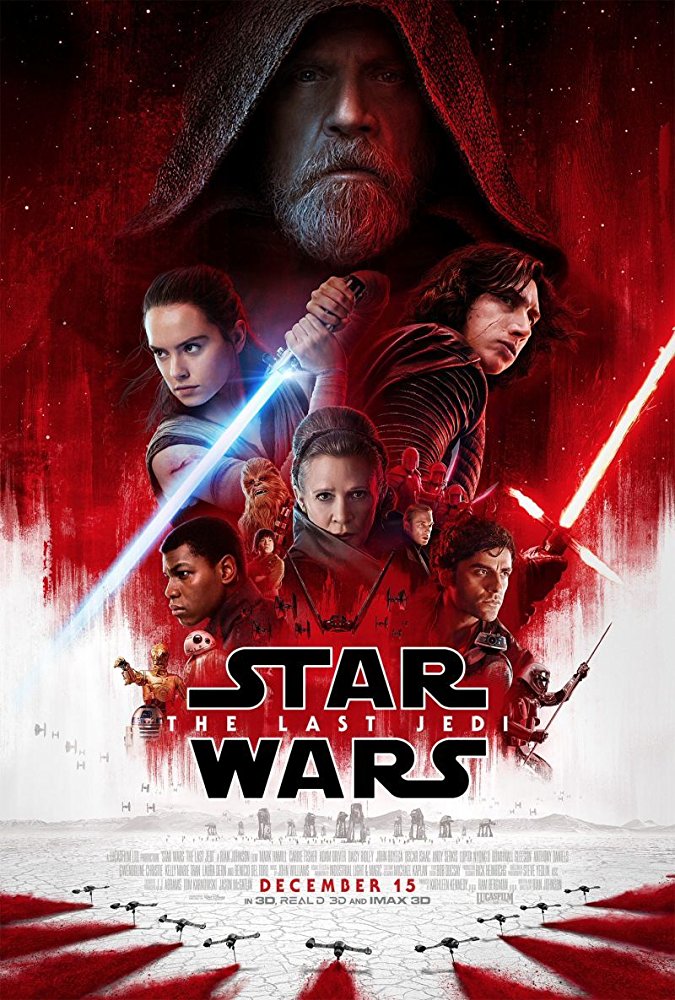
Star Wars: The Last Jedi

Star Wars: The Last Jedi 2017. Directed by Rian Johnson.

I can rarely be bothered to go to big releases in their opening week but I made an exception with this, the latest installment in the Star Wars franchise.

I should say from the outset that while I like the original movies, I’m film studies scholar – not in the simpering fan-girl brigade. In fact, I’ve always felt a degree of frustration because I could always see how good these films should be but never seemed to hit the mark.

Having said that, I thought The Force Awakens (2015) was infinitely better than any of the prequels and reignited my interest in the series. But this was completely eclipsed by the stand alone and beautifully self-contained Rogue One (2016), which (despite a baggy first act) is a fabulous sci-fi war movie.

But Thursday I saw something really good, much better than I anticipated, and I reacted accordingly.

The Last Jedi explored complex themes – in a far more nuanced way than I expected – about family, friendship, connection and the nature of difference and subversion. Given the global political climate this past 12 months, it was an excellent commentary, and a reminder that nothing is ever just black or white.

The young cast are really very good, with Daisy Ridley and Adam Driver outstanding, providing emotional depth to their characters. They are ably supported by John Boyega, Oscar Isaacs and Kelly Marie Tran. Despite being a wee bit sentimental about seeing Carrie Fisher in her final role (yes, I did well up!) the thing that reduced me to tears was seeing the wonderful Laura Dern showing all the kids how it should be done – and a scene that immediately reminded me of her father Bruce Dern and Silent Running (1972), one of my favourite films.

If this is what Star Wars is going to be from now on, I’ll have some more thanks!

* This is an expanded version of a review that was included in Kermode & Mayo’s Film Review on BBC 5 Live (15/12/17) – and yes, I was thrilled to hear Simon Mayo read it out! *


Previous Older Entries