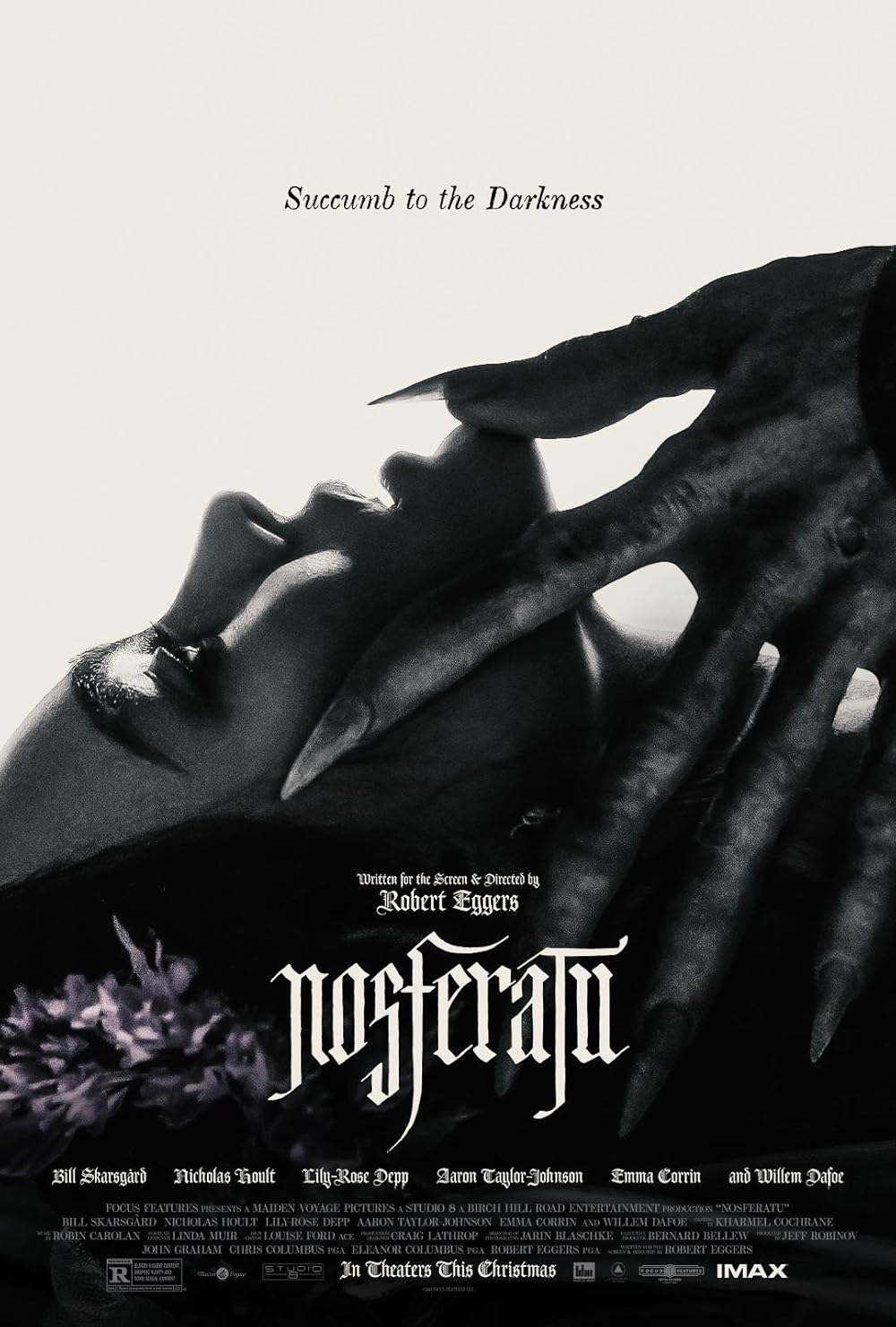
Nosferatu – Spoiler Free

Nosferatu 2024

Written and directed by Robert Eggers

Its been a shaky start to 2025 so I’m a little late to the party, but I finally got to see Nosferatu yesterday at my local, the State Cinema in North Hobart. This was perhaps my most anticipated release for the last year or more and I’m a big fan of Eggers’ work, my favourite being The Lighthouse (2019).

This is Eggers’ fourth feature and I feel he’s firmly secured his niche in folk horror, especially retelling of mythic stories for modern audiences. However, I felt this remake of F. W. Murnau’s 1922 silent classic wasn’t quite up to par. There are several interconnected factors here, which I’ll try to tease out without spoiling anything.

On the plus side, Eggers’ regular cinematographer, Jarin Blaschke is back, creating darkly beautiful and quite memorable visuals – I really can’t fault his work! As with his previous features, the framing and lighting are superb, creating painterly, gothic scenes that stay in the mind long after leaving the cinema. Similarly, the art direction (Robert Cowper, Paul Ghirandani), set decoration (Beatrice Brentnerova) and costume design (Linda Muir) are near perfect.

The sound design is, for the most part quite good. There is a visceral quality to the diegetic and foley sound in some scenes that adds depth to the horror but the soundtrack by Robin Carolan is disappointing. At times overbearing, it often makes the classic mistake of telegraphing to the audience “this is what you must feel &/or think” in key scenes. As a musician, this is one of my pet peeves, and it displays a lack of trust from the filmmaker that audiences can discern what’s going on without being beaten over the head by aural as well as visual cues. For the most part 21st century audiences are a lot more cineliterate than filmmakers give them credit for!

I suspect one of the reasons Carolan’s score is so bombastic is to push the action. Nosferatu is a slow and cumbersome beast to begin with, mostly I suspect because Eggers is trying to do justice to not only the Murnau version but Bram Stoker’s original novel and the multitude of media objects and resultant tropes that have arisen from such an iconic and foundational story in folk horror. This is also evident in the pacing and I take off my hat to film editor, Louise Ford (another Eggers regular), this would’ve been a nightmare to edit! I also wonder if this is why Eggers relied so heavily on jump scares, particularly in the first half of the film.

For the most part, the cast are excellent, with Nicholas Hoult showing yet again what an accomplished actor he’s become. Emma Corrin, Aaron Taylor-Johnson, Ralph Inerson and Willem Dafoe are all fine and, although he was under a lot of make up and prosthetics, Bill Skarsgard was suitably overbearing and downright horrible as Count Orlok. (By the way, I loved Orlok’s ‘tash – it was appropriate to the period and place.)

Sadly, the glaring exception is Lily-Rose Depp. Visually, she fits the part of Ellen Hutter superbly – she is the perfect poster girl for gothic loveliness and Jarin Blaschke’s camera loves her! Unfortunately, as soon as she opens her mouth, all bets are off as she chews the scenery with way too much vigour. Ellen is (with Orlok) arguably the central character and I’m aware that it’s a lot to ask of any actor but I feel this was just a step too far out of her range. To add insult, there is negligible chemistry between her and on-screen husband Nicholas Hoult as well as Bill Skarsgard’s Count and I was continually pulled out of the story by this.

Nevertheless, Nosferatu is obviously a passion project for Eggers and a wildly ambitious one at that. When it works, it’s great and, for the most part, (especially visually) it works. Its not perfect – but then, nothing is.

Nosferatu is currently in wide cinema release globally and I encourage everyone to see it just for the gorgeous cinematography. Let me know what you think!

The Northman

The Northman 2022

Directed by Robert Eggers. Screenplay by Robert Eggers and Sjon.

I saw The Northman in its opening weekend at a fairly well attended screening at The State, and from the opening scenes (unlike my last cinema outing) you could’ve heard pin drop. This chaotic and extremely bloody film is loosely based on the saga of Amleth, (also the inspiration for Shakespeare’s Hamlet) which forms part of the ‘Gesta Danorum’ or ‘History of the Danes’ from the 12th century.

Here, Eggers has teamed with Icelandic writer Sjon, who also wrote the screenplay for the much lauded Lamb (2021). The result is a mesmerising fever dream of epic proportions. Featuring Alexander Skarsgård, Anya Taylor-Joy, Claes Bang, Nicole Kidman and Ethan Hawke, this boasts a great supporting cast, including Willem Dafoe, Ingvar Sigurdsson and the wonderful Björk. The production was one of many delayed by Covid, but I think in this case, it has worked in favour of The Northman, with the end result a very polished production.

There are many, MANY fight sequences and they’re excellently choreographed by C C Smiff and shot by cinematographer Jarin Blaschke, a constant collaborator on all Eggers’ features. The framing throughout is superb but one scene in particular has stayed with me, a beserker raid on a village that contains a lengthy tracking shot through a village. Filmed in one take, it is wonderfully balletic as well as incredibly bloody. All praise too for stunt coordinator Jòn Vidar Ambórsson and his team, who really made me wince and occasionally, gasp for breath! The original soundtrack by Robin Carolan and Sebastian Gainsborough is perfect – front and centre when required and unobtrusive for the remainder. Similarly, there’s been a lot of work poured into costuming and historical accuracy, right down to a valkyrie with dental adornments and a he-witch in women’s clothing – real practices in Iron Age Viking culture.

Having a much bigger budget for this third feature has also opened up new horizons (literally) for Eggers. After the intentionally stifling feel of the New England forest (and Thomasin’s tiny family cabin) in The Witch (2015) and the similarly claustrophobic feel of The Lighthouse (2019), the broad horizons and multiple locations of The Northman give an appropriate sweeping, epic feel to this saga of vengeance and love. It fleetingly draws a shade of grey over Amleth’s quest (a thread that could’ve been pulled a little more I feel) but it remains a top class epic revenge saga.

If like me, you’re a fan of Eggers’ brand of visceral dark horror (yes, it is a horror movie), I’m sure you’ll enjoy this and, like his previous films, I’m sure this will stand repeated rewatching. But be aware, it isn’t for the squeamish or faint hearted. The Northman is currently in wide release globally and I suggest seeing it on the biggest screen possible. Very highly recommended.

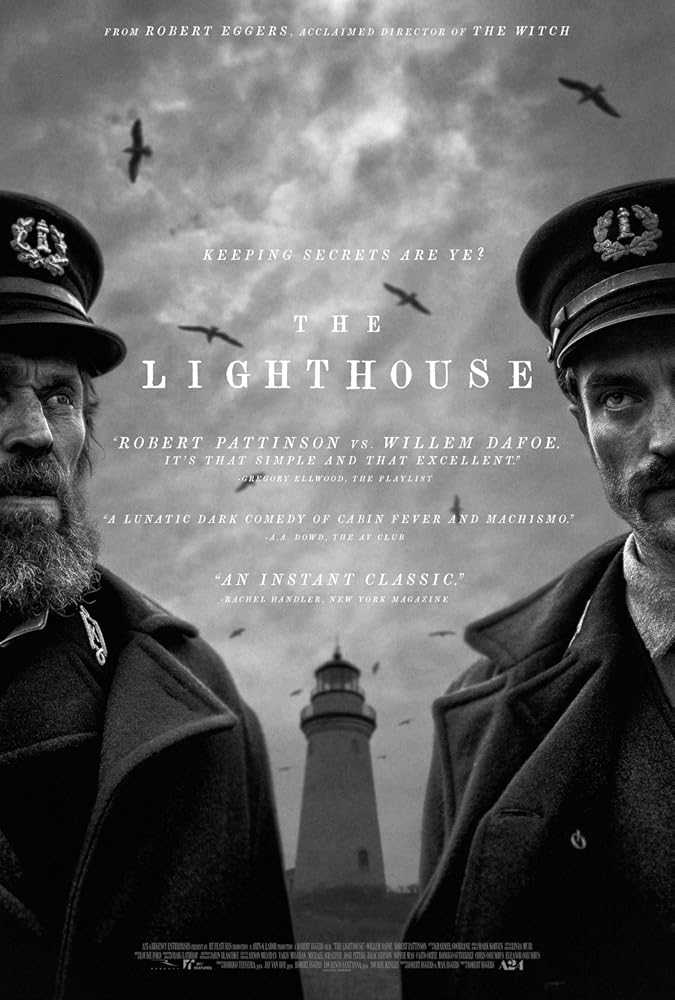
The Lighthouse

Willem Dafoe and Robert Pattinson in The Lighthouse (2019)

The Lighthouse (2019)

Written by Robert & Max Eggars. Directed by Robert Eggars.

As anyone who comes here regularly would know, I watch a lot of movies. Sometimes they are perfectly fine while up on the screen but don’t stay with me, and within hours I need to refer to notes made in the cinema to jog my memory into writing a review. Not so with Robert Eggars’ latest film – I found it truly memorable and cannot stop thinking about it!

The Lighthouse is many things, which makes it difficult to adequately describe without giving away massive plot spoilers – which I have no intention of doing. Suffice it to say, I found this seemingly simple story of two men alone in a lighthouse a riveting cinematic experience that becomes increasingly complex and deep. From the opening scene, this is a film that demands your full attention and becomes (at times) uncomfortably intense.

Willem Dafoe and Robert Pattinson star in this two-hander and both are excellent. I’ve come to expect this of Dafoe, who never disappoints, but Pattinson is extraordinary here and has become an actor of depth and serious value. There is surprisingly little dialogue between them but that is delivered with intent and tension. For a relatively quiet film, it’s very loud, with superb diagetic sound and a score that weaves through this isolated and desolate world.

For film nerds (like me), the movie was shot on 35 mm black and white film stock, using vintage Baltar lenses, which required much stronger lighting for the interior scenes, creating deeper contrasts and also forcing the almost square 1.19:1 (or Movietone) aspect ratio. This makes so much of the film ultra close up and at times, downright claustrophobic despite being so isolated. There are many seemingly small things like this that combine together to make this film a cinephile’s delight – the haunting sound design, the very specific dialects used by the actors, the atmospheric score by Mark Korven, the brilliant cinematography by Jarin Blaschke, and the superb editing by Louise Ford. All combine together to make a truly memorable cinematic experience.

Narratively, the story was drawn initially from an unfinished work by Edgar Allen Poe and a real-life incident from an early 19th century Welsh lighthouse. But at its heart, I think this has more in common with Greek tragedy – particularly Proteus, the prophetic sea god and Prometheus, the trickster who stole fire from the gods and was punished so horribly. Set in the late 19th century, this is a period piece that doesn’t exclude modern viewers. There are strong themes of the performative nature of work and masculinity, which are relatable audience entry points and become so very obvious as the layers of social norms are stripped away from the characters and their true natures revealed. And above all, the lighthouse – which almost becomes a character itself, in all its intense and claustrophobic isolation.

At times, The Lighthouse is a hard watch and if you’re not a fan of being challenged by a piece of cinema, I cannot recommend it to you. However, if you like horror that is cerebral as well as visceral, you’ve come to the right place. If there is a fault, it is a little over-long with a running time of 109 minutes, but I wonder now if that was intentional. Like Eggars’ previous feature, The Witch (2015) there are questions posed that are never answered. The existential horror at the core of this drama is arguably something that exists in all of us and here, Robert Eggars in concert with his excellent cast and crew, gradually peel away the artifice of societal expectations to reveal that dark heart.

The Lighthouse is currently in (relatively) wide release across Australia and I’d like to thank Monster Fest for the opportunity to see and review it.