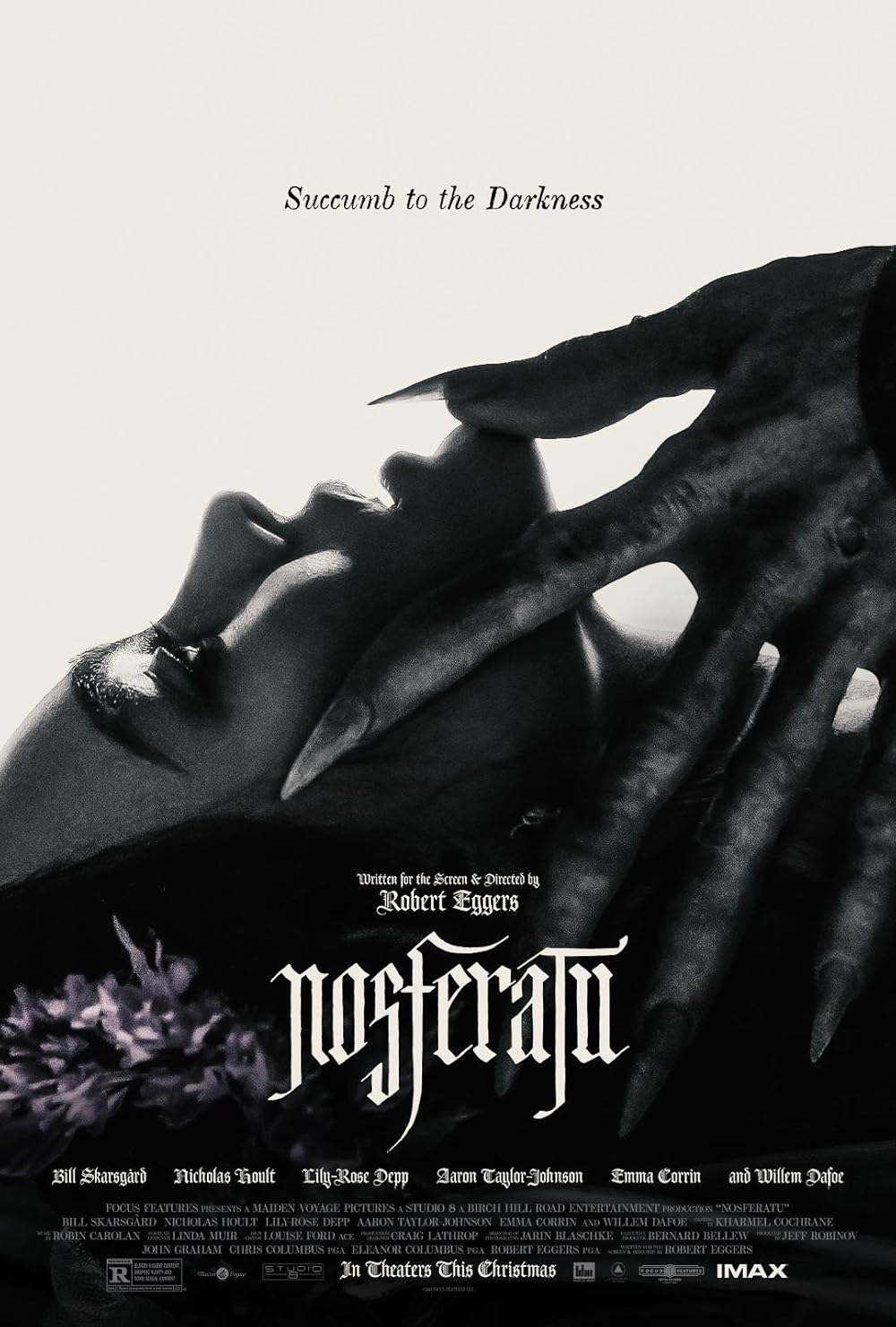
Nosferatu 2024
Written and directed by Robert Eggers
Its been a shaky start to 2025 so I’m a little late to the party, but I finally got to see Nosferatu yesterday at my local, the State Cinema in North Hobart. This was perhaps my most anticipated release for the last year or more and I’m a big fan of Eggers’ work, my favourite being The Lighthouse (2019).
This is Eggers’ fourth feature and I feel he’s firmly secured his niche in folk horror, especially retelling of mythic stories for modern audiences. However, I felt this remake of F. W. Murnau’s 1922 silent classic wasn’t quite up to par. There are several interconnected factors here, which I’ll try to tease out without spoiling anything.
On the plus side, Eggers’ regular cinematographer, Jarin Blaschke is back, creating darkly beautiful and quite memorable visuals – I really can’t fault his work! As with his previous features, the framing and lighting are superb, creating painterly, gothic scenes that stay in the mind long after leaving the cinema. Similarly, the art direction (Robert Cowper, Paul Ghirandani), set decoration (Beatrice Brentnerova) and costume design (Linda Muir) are near perfect.
The sound design is, for the most part quite good. There is a visceral quality to the diegetic and foley sound in some scenes that adds depth to the horror but the soundtrack by Robin Carolan is disappointing. At times overbearing, it often makes the classic mistake of telegraphing to the audience “this is what you must feel &/or think” in key scenes. As a musician, this is one of my pet peeves, and it displays a lack of trust from the filmmaker that audiences can discern what’s going on without being beaten over the head by aural as well as visual cues. For the most part 21st century audiences are a lot more cineliterate than filmmakers give them credit for!
I suspect one of the reasons Carolan’s score is so bombastic is to push the action. Nosferatu is a slow and cumbersome beast to begin with, mostly I suspect because Eggers is trying to do justice to not only the Murnau version but Bram Stoker’s original novel and the multitude of media objects and resultant tropes that have arisen from such an iconic and foundational story in folk horror. This is also evident in the pacing and I take off my hat to film editor, Louise Ford (another Eggers regular), this would’ve been a nightmare to edit! I also wonder if this is why Eggers relied so heavily on jump scares, particularly in the first half of the film.
For the most part, the cast are excellent, with Nicholas Hoult showing yet again what an accomplished actor he’s become. Emma Corrin, Aaron Taylor-Johnson, Ralph Inerson and Willem Dafoe are all fine and, although he was under a lot of make up and prosthetics, Bill Skarsgard was suitably overbearing and downright horrible as Count Orlok. (By the way, I loved Orlok’s ‘tash – it was appropriate to the period and place.)
Sadly, the glaring exception is Lily-Rose Depp. Visually, she fits the part of Ellen Hutter superbly – she is the perfect poster girl for gothic loveliness and Jarin Blaschke’s camera loves her! Unfortunately, as soon as she opens her mouth, all bets are off as she chews the scenery with way too much vigour. Ellen is (with Orlok) arguably the central character and I’m aware that it’s a lot to ask of any actor but I feel this was just a step too far out of her range. To add insult, there is negligible chemistry between her and on-screen husband Nicholas Hoult as well as Bill Skarsgard’s Count and I was continually pulled out of the story by this.
Nevertheless, Nosferatu is obviously a passion project for Eggers and a wildly ambitious one at that. When it works, it’s great and, for the most part, (especially visually) it works. Its not perfect – but then, nothing is.
Nosferatu is currently in wide cinema release globally and I encourage everyone to see it just for the gorgeous cinematography. Let me know what you think!

 Debra Manskey